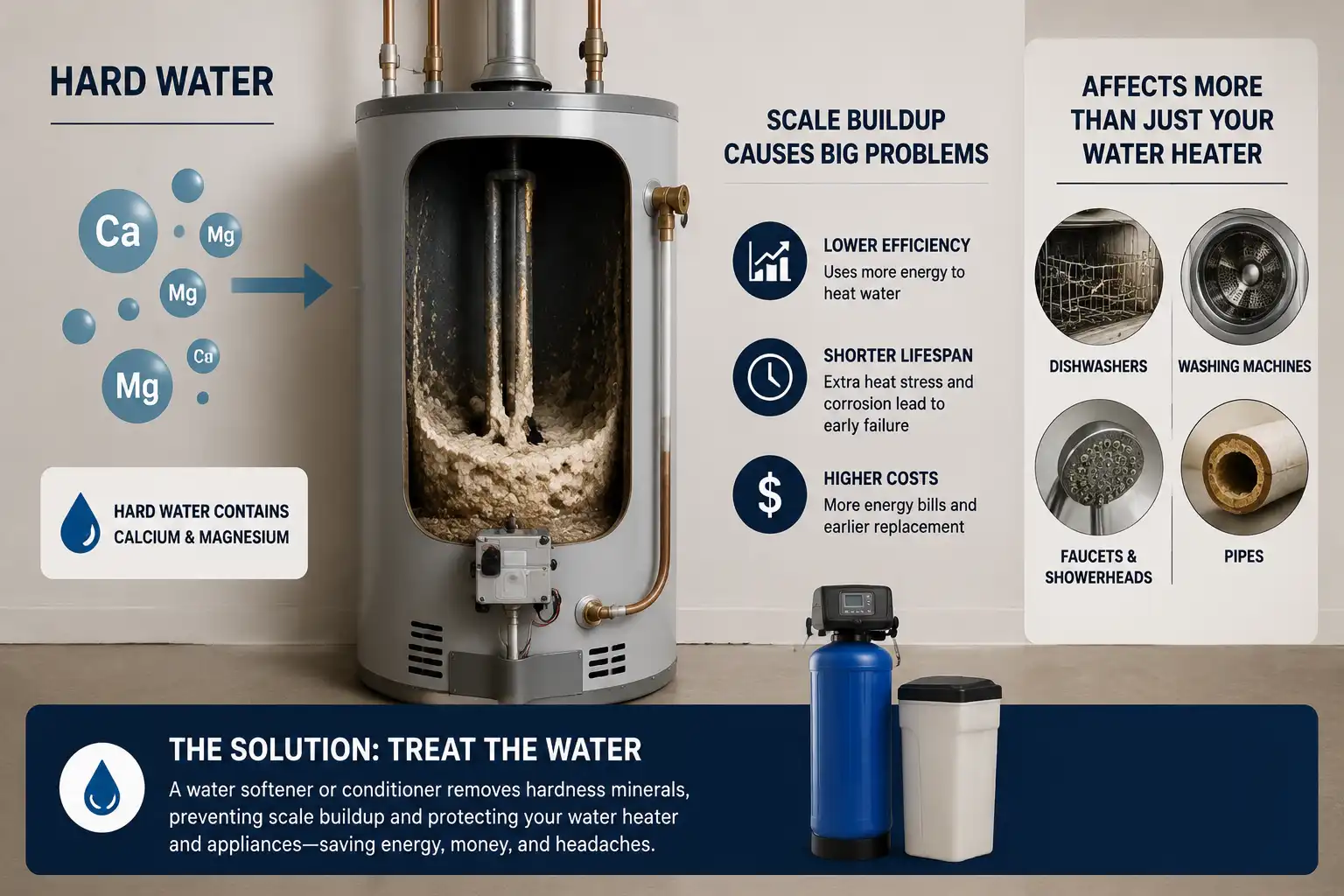
Hard water does its most expensive damage where you cannot see it: inside your water heater and your water-using appliances. The calcium and magnesium that make water hard settle out as scale, and over time that scale steals efficiency, drives up energy bills, and cuts years off equipment you expected to last a decade or more. Here is how it happens and what it costs you.
What Hard Water Does Inside a Water Heater
When hard water is heated, the dissolved minerals fall out of solution and settle as a layer of sediment and scale at the bottom of the tank and on the heating elements. In a tank heater, that sediment layer sits between the burner or element and the water, acting as insulation. The heater has to work harder and longer to push heat through the scale to warm the water, which means more energy burned for the same hot shower.
That popping and rumbling many people hear from an aging water heater is this sediment. Water gets trapped under the scale layer, boils, and forces its way out with a knocking sound. Understanding what that sediment noise actually is is the clearest early sign hard water is building up inside the tank.
The Efficiency and Lifespan Cost
Scale buildup hits you twice. First, the heater runs longer to overcome the insulating layer, so your energy use climbs steadily even though nothing looks wrong. Second, the extra heat stress and the corrosive environment created by sitting sediment shorten the tank’s life. A water heater that should last ten to twelve years can fail years early on hard water, and the cost of repairing versus replacing a water heater is a decision hard water forces sooner than it should.
Tankless heaters are not immune. Scale narrows the heat exchanger passages, triggers error codes, and reduces output, which is why tankless units in hard-water homes need descaling on a schedule to hold their efficiency.
It Is Not Just the Water Heater
The same scale that coats a water heater builds up in every appliance that uses hot water. Dishwashers and washing machines lose efficiency and wear out faster, faucets and showerheads clog with mineral deposits, and pipes gradually narrow. The water heater is simply where the damage is fastest and most expensive, because heat accelerates scale formation.
How to Slow the Damage
Two things help. Regular maintenance removes the sediment before it does lasting harm, and draining and flushing the water heater on a schedule is the single most effective habit for a hard-water home. In the Lowcountry, where municipal water runs moderately hard, a more frequent sediment flush is worth building into your routine.
The permanent fix is treating the water before it ever reaches the heater. A water softener removes the hardness minerals so scale never forms, protecting the heater and every appliance downstream, and sizing that softener correctly ensures it keeps up with your home. On moderately hard water, even a salt-free conditioner reduces the scale that shortens equipment life.
The Bottom Line
Hard water is a slow, hidden expense that shows up as higher energy bills and appliances that die early. Flushing the water heater regularly buys time, but treating the water at the source is what actually protects your equipment. If your heater is already noisy or losing efficiency, professional water heater repair in Goose Creek can assess the sediment damage, and scheduled flush maintenance keeps it running efficiently once it is clean.