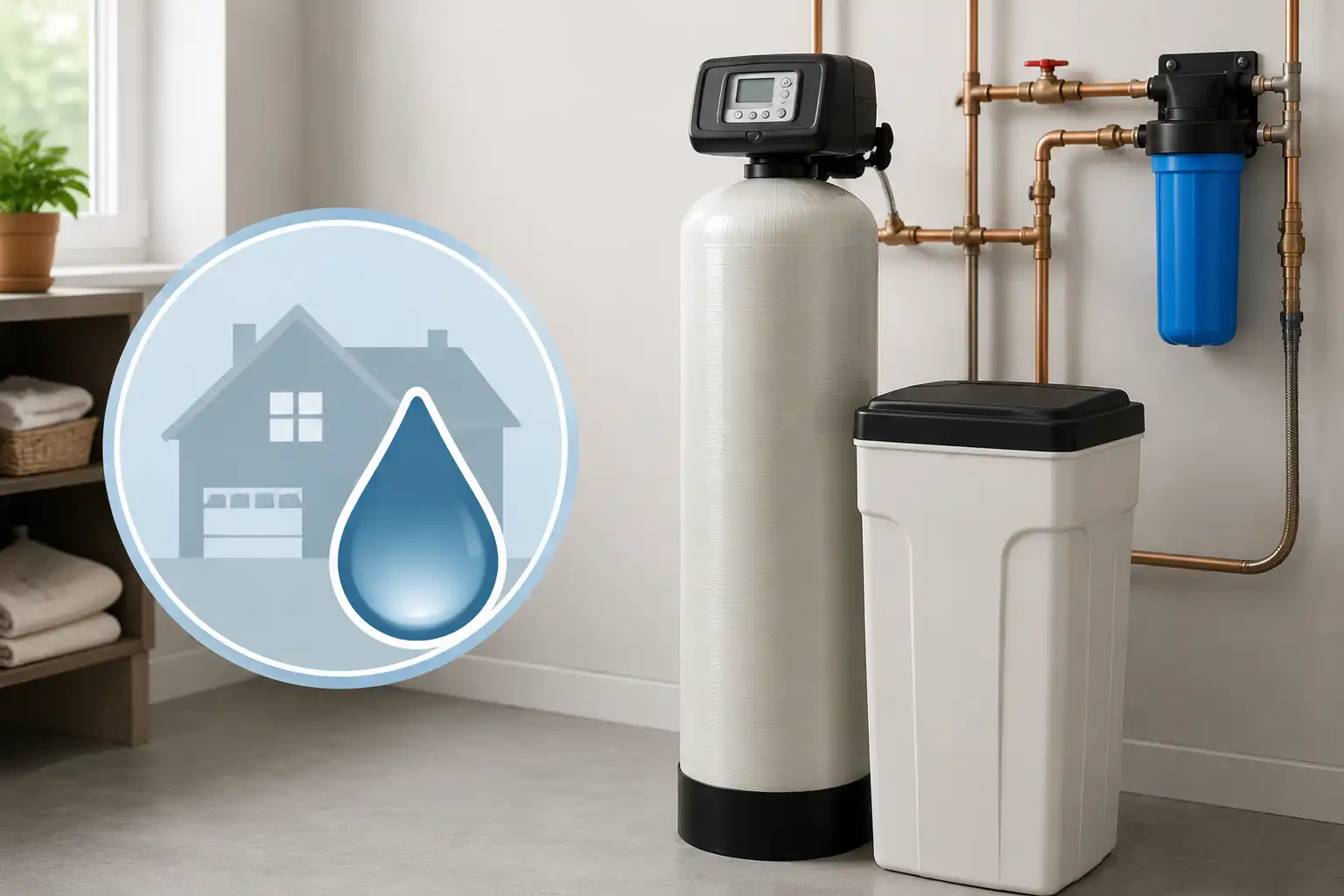
Buying a water softener that is too small means it cannot keep up and you get hard water anyway. Too large, and you waste money and salt on a unit that regenerates inefficiently. Sizing a softener correctly is a simple calculation once you have two numbers: how hard your water is and how much of it your household uses. Here is how to do the math.
The Two Numbers You Need
Softener capacity is measured in grains, meaning how many grains of hardness the unit can remove before it has to regenerate. To find the right capacity, you need your water hardness in grains per gallon (GPG) and your household’s daily water use in gallons.
Finding Your Water Hardness
On city water, your local utility publishes an annual water quality report with the hardness level, or you can use a test kit. If the report lists hardness in parts per million (PPM) or milligrams per liter, divide by 17.1 to convert to GPG. For reference, water is considered soft at 0 to 3 GPG, moderately hard at 4 to 7, hard at 8 to 12, and very hard above 12. If you are on well water and it contains iron, add 5 GPG to your hardness number for every 1 PPM of iron, since iron loads the softener too.
Finding Your Daily Water Use
Multiply the number of people in your home by the average daily use per person, which runs about 75 to 80 gallons. A four-person household uses roughly 300 gallons a day. You can also check your water bill and divide the billing-period total by the number of days for a more exact figure.
The Formula
Multiply your daily water use by your hardness level to get your daily softening requirement in grains: people x daily gallons x hardness GPG = grains per day. For a four-person home using 300 gallons a day with moderately hard water at 8 GPG, that is 300 x 8 = 2,400 grains per day.
Softeners are designed to regenerate about every 5 to 7 days, and you size to roughly 75 percent of capacity to leave a reserve for heavy-use days. Using our example, 2,400 grains a day over a week is about 16,800 grains, so a common 24,000 or 32,000-grain unit fits comfortably with reserve to spare. Most households land on a 32,000 to 48,000-grain softener, with larger families or very hard water moving up to 64,000 grains.
Why Not Just Buy the Biggest One
Oversizing seems safe but it is not free. A softener that is far larger than your demand regenerates too infrequently, which can let the resin bed channel, meaning water carves paths through it and bypasses the resin, reducing effectiveness. It also costs more up front. Right-sizing gives you consistent soft water and efficient salt and water use, which is the whole point.
A Goose Creek Example
Say a Goose Creek family of four is on municipal water the utility reports at around 7 GPG. Their daily requirement is 300 x 7 = 2,100 grains, or about 14,700 grains a week. A 32,000-grain unit regenerating roughly weekly at 75 percent capacity handles that with a healthy reserve for guests or a heavy laundry week. The exact hardness number is the variable that matters most, so getting it from the utility report or a test is step one.
Getting It Right
The calculation is straightforward, but iron content, peak-use patterns, and the specific unit’s efficiency all fine-tune the choice. If you are deciding between softening approaches first, the difference between salt-based and salt-free systems decides what you are even sizing. Professional water softener installation in Goose Creek starts by testing your actual water and calculating the capacity for your household, so the unit you install keeps pace without wasting salt. Once it is in, knowing the signs it is working lets you confirm it is sized right.