Most water heaters are ignored until something goes wrong. That’s understandable, but it’s also the reason so many homeowners end up replacing a unit years earlier than they should. A water heater that gets regular maintenance will outlast one that doesn’t by a significant margin, and the annual cost of a professional flush and tune-up is a fraction of what a premature replacement costs. Our team handles water heater maintenance for tank and tankless systems across Goose Creek and the Tri-County area. Getting ahead of the problem is almost always the smarter call. Book your tune-up by calling us at (843) 572-8522.
A water heater works every day without most homeowners giving it much thought. That kind of constant use, combined with the mineral-heavy water common in the Lowcountry, leads to sediment buildup, component wear, and efficiency loss over time. Here’s what the data shows.
Sediment that settles at the bottom of a tank insulates the water from the burner, forcing the unit to work harder and run longer to reach the set temperature. Over time, that added strain shortens the life of the heating element and the tank itself. Flushing annually removes that sediment before it becomes a long-term problem.
A tank with significant buildup uses noticeably more energy to heat the same amount of water. That extra energy cost adds up month after month on the utility bill.
The anode rod inside a tank water heater is designed to corrode so the tank doesn’t. When the anode rod is depleted and not replaced, the tank itself begins to corrode. Catching a depleted anode rod during maintenance prevents the leak that comes next.
Many water heater manufacturers include regular maintenance as a condition of their warranty coverage. A unit that fails prematurely and has no maintenance history may not be covered.
If your water heater is showing any of these signs, don’t wait for the annual cycle to schedule a visit.
These sounds come from sediment at the bottom of the tank being disturbed as water heats around it. It's one of the clearest signs that a flush is overdue.
Rust-colored water at the hot tap usually means the inside of the tank has begun to corrode. Catching this early gives you the option of anode rod replacement before the tank fails.
If the water is taking longer to reach temperature than it used to, sediment buildup is the most common cause. Efficiency has dropped and the unit is working harder to compensate.
An inefficient water heater is often the cause of a gradual increase in energy costs that homeowners attribute to other things.
Any moisture around the base of the unit should be investigated immediately. It may be condensation, but it can also be an early-stage tank leak.
If your water heater has never been flushed or inspected, it's overdue regardless of how it's performing right now.
A full water heater maintenance visit covers every component that affects performance, safety, and longevity.
We connect a hose to the drain valve and flush the tank until the outflow runs clear, removing accumulated sediment from the bottom of the tank.
We pull the anode rod to assess its condition. A rod that is more than 50 percent depleted gets replaced to protect the tank from corrosion.
The T&P valve is a safety device designed to release pressure if the tank overheats or over-pressurizes. We test it to confirm it opens and closes properly. A T&P valve that has never been tested and has been stuck in the closed position for years is a liability.
We verify the thermostat is reading and controlling temperature accurately. The standard safe setting is 120 degrees Fahrenheit, which prevents scalding and inhibits bacterial growth.
We check all water line connections and the gas or electrical connections for signs of wear, corrosion, or loose fittings.
For gas-fired water heaters, we verify the gas pressure at the unit is within the manufacturer’s specified range.
We check the flue and venting connections to confirm there are no blockages or separations that could allow combustion gases to enter the living space.
For most homes, an annual flush is the right schedule. Homes in areas with harder water benefit from flushing every six months because mineral deposits accumulate faster. The water in Goose Creek and the surrounding Lowcountry area carries enough mineral content that staying on top of annual flushing is worth doing consistently.
For tankless water heaters, the equivalent maintenance task is descaling the heat exchanger. Most tankless units benefit from descaling every 12 to 18 months. Without it, scale builds up inside the heat exchanger, reduces efficiency, and shortens the life of the unit.
The maintenance approach differs depending on which type of unit you have.
Tank units require an annual flush to remove sediment, an anode rod inspection and replacement as needed, a T&P valve test, and a thermostat and connection check. These tasks take about an hour and directly extend the life of the unit.
Tankless units don’t accumulate sediment the same way tanks do, but scale builds up inside the heat exchanger from dissolved minerals in the water. Descaling involves flushing a food-grade descaling solution through the heat exchanger to dissolve the buildup. The inlet filter screen also needs to be cleaned periodically to maintain proper flow through the unit.
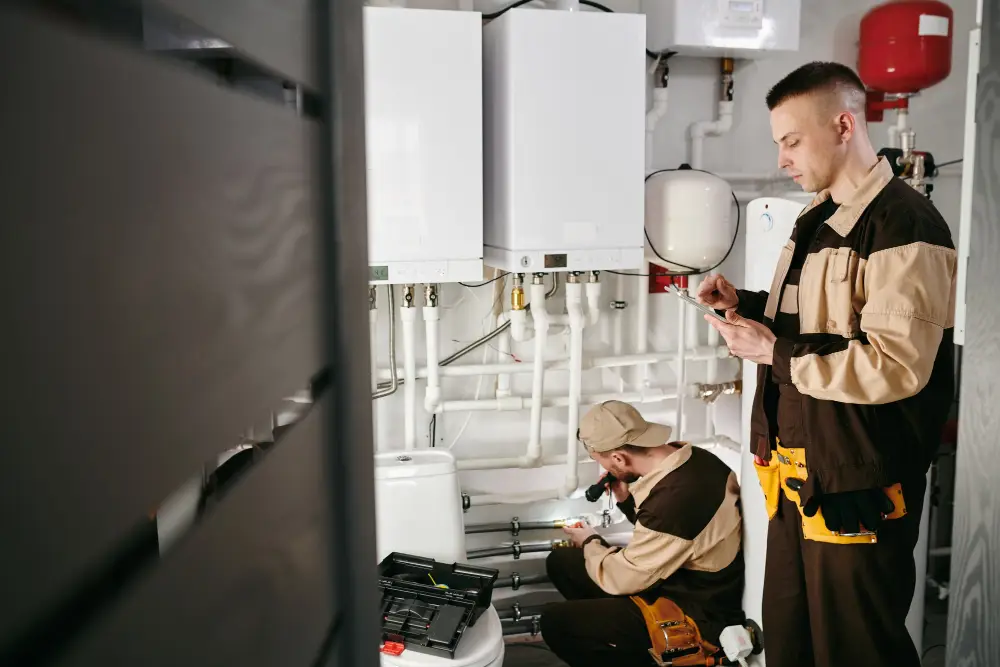
Some homeowners flush their own water heaters, and it’s a reasonable task for someone comfortable with basic plumbing. Connecting a hose to the drain valve, turning off the cold supply, and letting the tank drain is manageable. What’s harder to do at home is checking the anode rod, testing the T&P valve properly, verifying gas pressure, and inspecting the venting for issues that aren’t visible from the outside.
A professional maintenance visit covers all of those things in one appointment and gives you a clear picture of the unit’s condition. It also creates a documented service record, which matters for warranty purposes and when it’s time to sell the home.
A single professional maintenance visit for a tank water heater typically costs between $99 and $250, depending on the scope of the service and the condition of the anode rod. Anode rod replacement adds to the cost if a new rod is needed. Tankless descaling typically falls in a similar range.
Ask about our annual maintenance plan, which includes a scheduled visit each year, priority scheduling, and a service discount on any repairs needed during the visit.
EXCELLENTTrustindex verifies that the original source of the review is Google. I hired Muller's Plumbing to fix the plumbing in my shower and they were great. Very professional, polite, worked looked great, arrived on time and worked in a timely fashion. I would hire them again.Posted onTrustindex verifies that the original source of the review is Google. Knowledgeable and ready to get it done. Made the whole process of dealing with the insurance co, leak detection, restoration company SEAMLESS. Took all the stress away from a very stressful problem.Posted onTrustindex verifies that the original source of the review is Google. I needed to have a plumber come out on a Friday afternoon to check on a possible water leakage and Mueller Plumbing was able to come out in a timely manner and able to find the issue and fixed it quickly. Highly Recommend.Posted onTrustindex verifies that the original source of the review is Google. They were the only company in goose creek that would help us in a timely fashion. They shuffled around a few things to make sure my restaurant was able to stay open! We will use them again!Posted onTrustindex verifies that the original source of the review is Google. Grant installed our water heater a few years back, so I called him when we needed work done recently. He is very knowledgeable about the work he does, and he likes to make sure you are good to go before he leaves! One thing I would recommend, as with any company, make sure you are clear on pricing and what your quote covers.Posted onTrustindex verifies that the original source of the review is Google. I had Mr. Mueller come all the way out from Goose Creek to fix a burst pipe. He came and fix it quickly. I would recommend him to others, as he was honest in his work.Posted onTrustindex verifies that the original source of the review is Google. Grant is polite and an expert in his craft. I called him about a leak under my house and felt immediately reassured. He responds to calls with a degree of professionalism and motivation unmatched by most other tradesmen, and I feel utterly certain that he will be my plumber of choice for the foreseeable future.Posted onTrustindex verifies that the original source of the review is Google. Mueller Plumbing did an amazing job replacing a water heater in my mother's house. Clean, fast service. Very professionalPosted onTrustindex verifies that the original source of the review is Google. Had the pleasure of working with Mr. Mueller today to replace my kitchen faucet, his service was excellent and quick. Highly recommend to anyone and based of other reviews the consensus is nothing but good things to say all around. Will definitely be calling him again with any future issues.
Rather than trying to remember to schedule a tune-up each year, our maintenance plan handles it for you. Members get an annual water heater service visit on a schedule we coordinate in advance, priority scheduling for repair calls, and preferred pricing on any parts or repairs identified during the visit. It’s a straightforward way to stay ahead of water heater problems without having to keep track of it yourself. Ask us about enrollment when you schedule your first visit.
Once a year is the standard recommendation for most homes. Homes with harder water may benefit from flushing every six months. If the unit hasn’t been flushed in several years, a professional flush is worth doing sooner rather than later.
You can perform a basic flush by connecting a hose to the drain valve, shutting off the cold supply, and draining the tank. What you won’t be doing yourself is checking the anode rod, testing the T&P valve, verifying gas pressure, or inspecting the venting. A professional visit covers all of those in one appointment.
Yes, and the evidence is consistent. Units that are flushed regularly and have their anode rod replaced as needed outlast neglected units by several years. The cost of annual maintenance is considerably less than the cost of an early replacement.
An anode rod is a metal rod, usually made of magnesium or aluminum, that runs through the center of a tank water heater. It is designed to corrode slowly so the steel tank doesn’t. When the rod is fully depleted, the tank itself starts to corrode. Replacing the rod before it’s gone is one of the most cost-effective things you can do to extend the life of a tank water heater.
Yes. The maintenance is different from a tank unit, but it’s equally important. Tankless heat exchangers accumulate scale from dissolved minerals in the water. Descaling every 12 to 18 months keeps the unit running efficiently and prevents the premature heat exchanger failure that comes from years of scale buildup.
Let’s ask something to us! Reach out I’d love to hear about your question about our services.
