When a sewer line fails, the repair method you choose determines not just the cost but how much of your yard, driveway, and landscaping gets torn up. There are two approaches: traditional excavation, which digs a trench to reach the pipe, and trenchless repair, which fixes or replaces the line with little to no digging. The trenchless price per foot can look higher at first, but once restoration is added, the math often flips. Here is how to compare them honestly.
Traditional Excavation
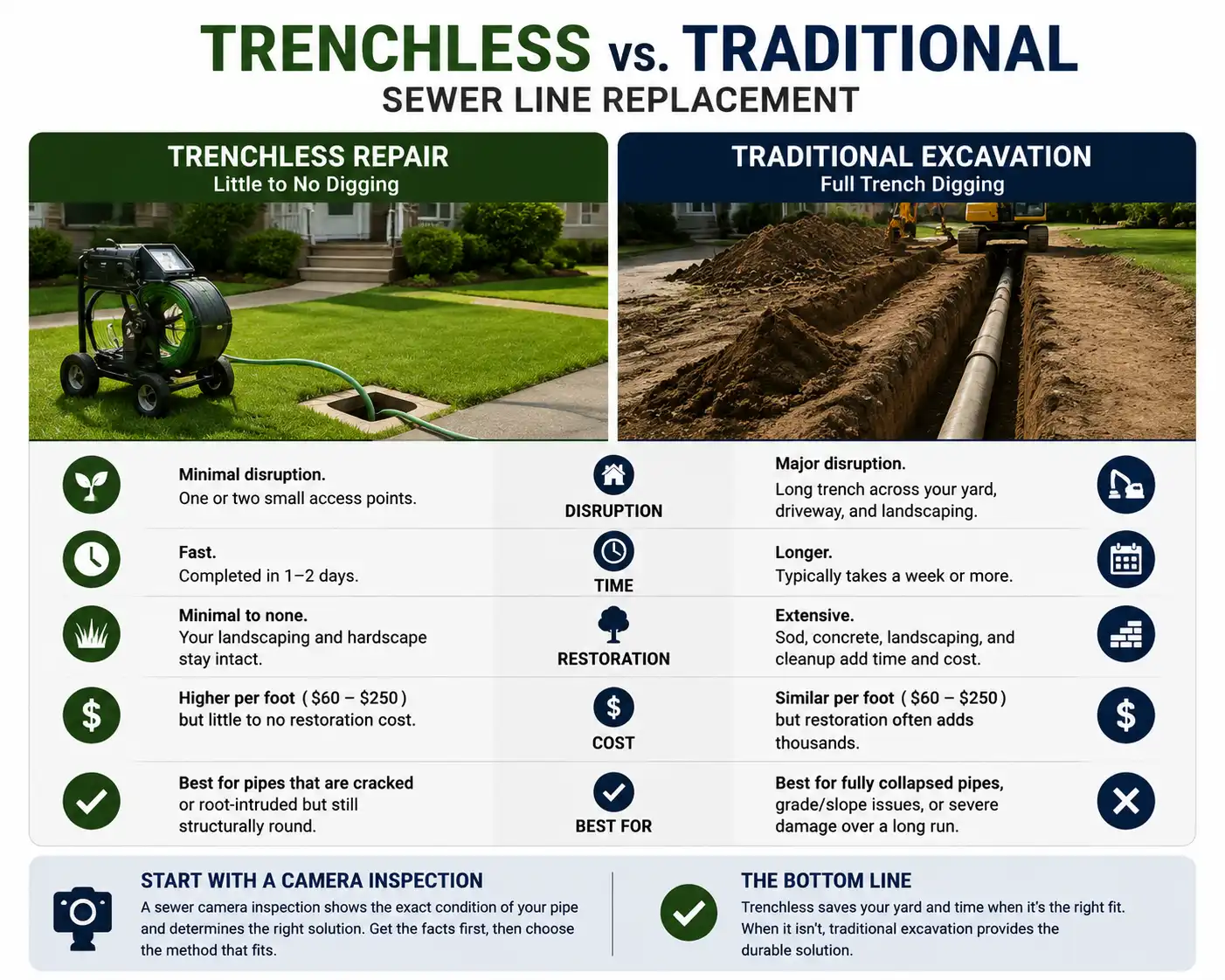
The traditional method digs a trench along the path of the damaged pipe, exposes it, replaces the failed section, and refills the trench. For a line running from the house to the street, that can mean a trench several feet deep and 50 to 100 feet long across your front yard. It is a proven method that works in every situation, including ones trenchless cannot handle.
The drawback is disruption. A long trench destroys the lawn, may require cutting through a driveway or walkway, and can damage the roots of mature trees. The restoration afterward, re-sodding, repaving, replanting, is often more expensive and time-consuming than the plumbing itself, and the work typically takes a week or more with the yard unusable throughout.
Trenchless Repair
Trenchless methods rehabilitate or replace the pipe using just one or two small access points. There are two main types. Pipe lining, or CIPP, inserts a resin-coated liner into the existing pipe and cures it in place, creating a new seamless pipe inside the old one. It suits a pipe that is cracked or root-intruded but still structurally round. Pipe bursting pulls a new pipe through the path of the old one while breaking the old pipe outward, and it fully replaces a line that is too far gone to line.
Because there is no long trench, trenchless finishes in one to two days instead of a week, and it leaves your landscaping and hardscape intact. The seamless liner also resists the root intrusion and joint separation that cause future failures, which is why many come with long warranties.
The Real Cost Comparison
Per foot, the two methods can look similar, roughly $60 to $250 depending on conditions. The difference is restoration. Traditional excavation adds the cost of replacing everything the trench destroyed, which can run thousands in sod, concrete, and landscaping. Trenchless avoids nearly all of that. Once restoration is included, trenchless is frequently the more cost-effective choice overall, and over a ten-year view the gap widens because the jointless liner rarely needs repeat repairs.
When Trenchless Does Not Work
This is where the trenchless-is-always-better story breaks down, and an honest plumber will tell you so. A fully collapsed pipe that has lost its round shape cannot have a liner pulled through it. A line with a grade or slope problem, where the pipe needs to be re-pitched to drain correctly, requires digging to reset it. And severe structural damage over a long run sometimes makes full excavation the practical choice. In these cases, traditional excavation is not the fallback, it is the right method.
The Decision Starts With a Camera
No responsible plumber recommends a method without seeing inside the pipe first. A sewer camera inspection shows the pipe’s exact condition, whether it is round and linable or collapsed and needing excavation, and locates the damage to the foot. Get the scope done, understand what the camera showed, then evaluate which method fits. If the line is intact enough to line, trenchless sewer repair in Goose Creek saves your yard. If the damage calls for it, full sewer line replacement done by excavation is the durable answer. Either way, the camera footage should justify the recommendation before you sign anything.