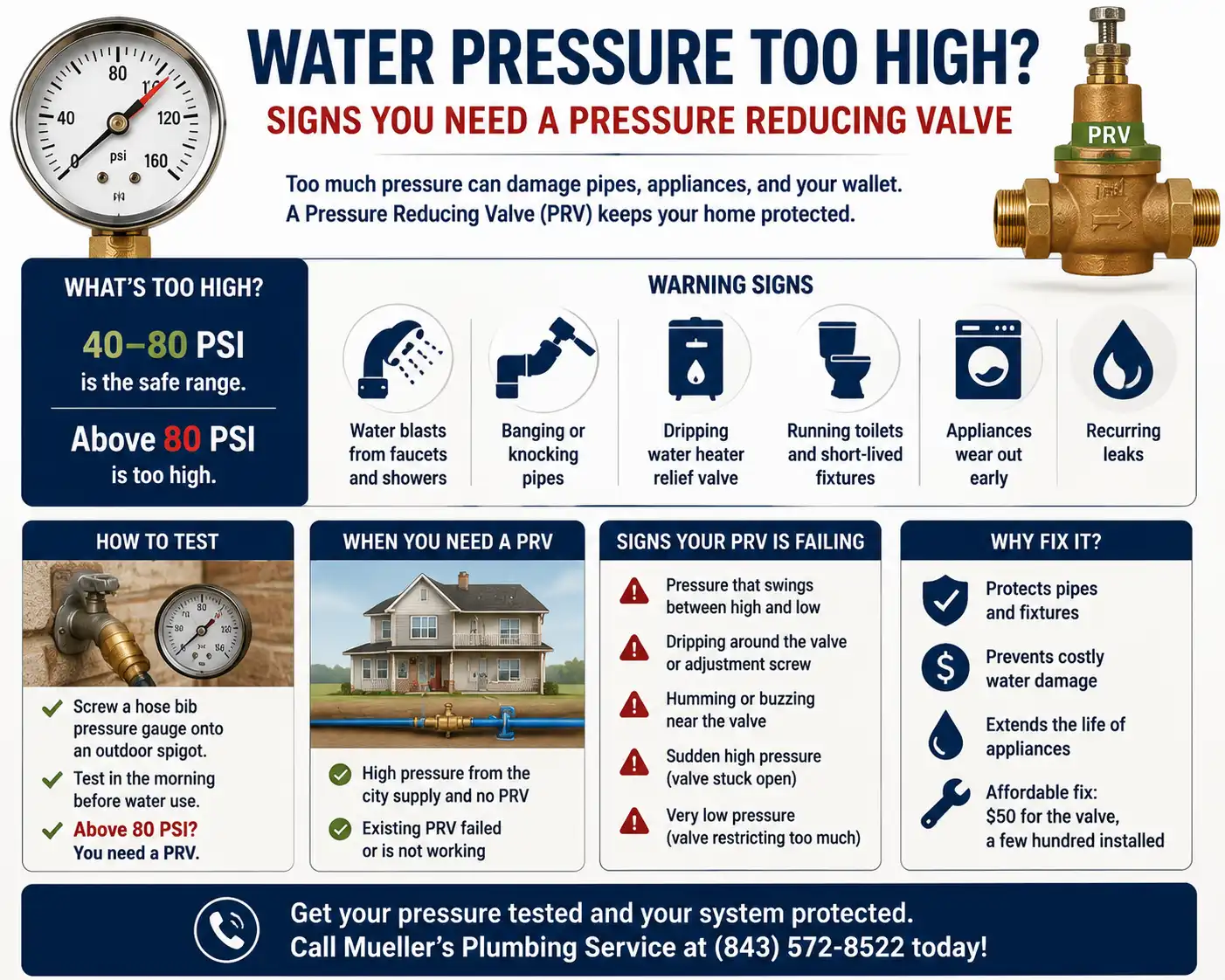
Strong water pressure feels great in the shower, so most people never think of it as a problem. But water pressure that runs too high is one of the quiet ways a plumbing system wears itself out. It strains pipes, shortens the life of your water heater and appliances, and drives up the odds of a leak. The fix is often a small, inexpensive device called a pressure reducing valve.
This post covers what healthy pressure looks like, the warning signs that yours is too high, how to test it yourself for a few dollars, and when it is time to bring in a plumber.
What counts as too high
Home plumbing is built to run safely between about 40 and 80 psi, which stands for pounds per square inch. Below 40, water feels weak. Above 80, you are in the danger zone, and the extra force works against your whole system every minute of the day.
Water pressure coming from the municipal supply is often higher than a house should take, especially for homes at a lower elevation or near a booster pump station. That is exactly what a pressure reducing valve, or PRV, is for. It sits on your main water line, usually near where the line enters the home, and steps the incoming pressure down to a safe level before it reaches your pipes.
The warning signs of high pressure
Some clues are obvious and some are easy to blame on something else. Watch for these:
- Water that blasts out. Faucets and showerheads that hit with real force, or that spit and splash even at a moderate setting.
- Banging or knocking pipes. A loud knock when you shut a faucet quickly, often called water hammer, is a classic sign of too much pressure.
- A dripping water heater relief valve. The temperature and pressure valve on your water heater opens when pressure gets too high. If it drips or discharges, pressure is a prime suspect.
- Running toilets and short lived fixtures. Toilet valves that leak, faucets that drip soon after repair, and fill valves that wear out fast can all point back to pressure.
- Appliances wearing out early. Dishwashers and washing machines are built for a pressure range. Feed them too much and their parts fail sooner.
- Recurring leaks. If you keep chasing small leaks around the house, the underlying cause may be the pressure pushing on every joint, which is where professional leak detection helps.
Any one of these on its own might be something else. Two or three together are a strong hint that your pressure is running high.
How to test your pressure
You do not need a plumber to get a first reading. A hose bib pressure gauge costs under fifteen dollars at any hardware store. Thread it onto an outdoor spigot and read the dial.
Test in the morning before the house has used much water. If the gauge reads consistently above 80 psi, your system is running too high and needs attention.
One more tip. If you are seeing the warning signs but your reading looks normal, test again at different times, especially in the evening. Municipal pressure can climb at night when demand across the neighborhood drops, so a house can sit fine during the day and spike after dark.
When you need a PRV, and when yours has failed
There are two situations that call for action.
The first is a home with no PRV at all that is receiving high pressure from the city line. Here the answer is to install one. It is a straightforward job that protects everything downstream of it.
The second is a home that already has a PRV that is wearing out. These valves are not permanent. They typically last 10 to 15 years, and hard water or constant pressure swings can shorten that. A failing PRV shows its own signs:
- Pressure that swings between strong and weak, often the first clue.
- A steady drip around the body of the valve or its adjustment screw, which means an internal seal has gone.
- A humming or buzzing near the valve, a sign the internal spring or diaphragm is worn.
- Water that suddenly runs at full city pressure, which can mean the valve is stuck open.
A failing PRV can also cause the opposite problem. If it restricts flow too much, you get weak pressure across the whole house.
Why this is worth fixing quickly
It is tempting to live with strong pressure because it does not feel like a problem. But the cost of ignoring it adds up. High pressure can rupture pipes, force appliances to fail early, waste water, and in a bad case contribute to serious water damage that leads to a full repipe. Set against that, a PRV is cheap. The valve itself runs around fifty dollars, and professional installation is a few hundred, far less than the damage a burst line or a failed water heater can cause.
Related reading
- How Long Does Whole-House Repiping Take? The Process Explained
- PEX vs Copper Piping: Which Is Best for Coastal South Carolina?
Get an accurate reading and a real fix
Diagnosing and replacing a PRV is not a do it yourself job for most homeowners. It sits on the main line, it has to be set to the right pressure, and getting it wrong causes its own problems. A plumber can measure your pressure accurately, inspect the valve, and either adjust, repair, or replace it as needed.
If your water feels too strong, your pipes bang, or your fixtures keep failing in Goose Creek, Hanahan, North Charleston, Summerville, or the greater Charleston area, Mueller’s Plumbing Service can test your pressure and install or replace a pressure reducing valve to protect your home. Call us at (843) 572-8522 to schedule a visit.