When a plumber tells you the whole house needs to be repiped, the first worry is usually not the pipes. It is the disruption. How many days will this take, how long will the water be off, and will you have to move out. Those are fair questions, and the answers are better than most people fear.
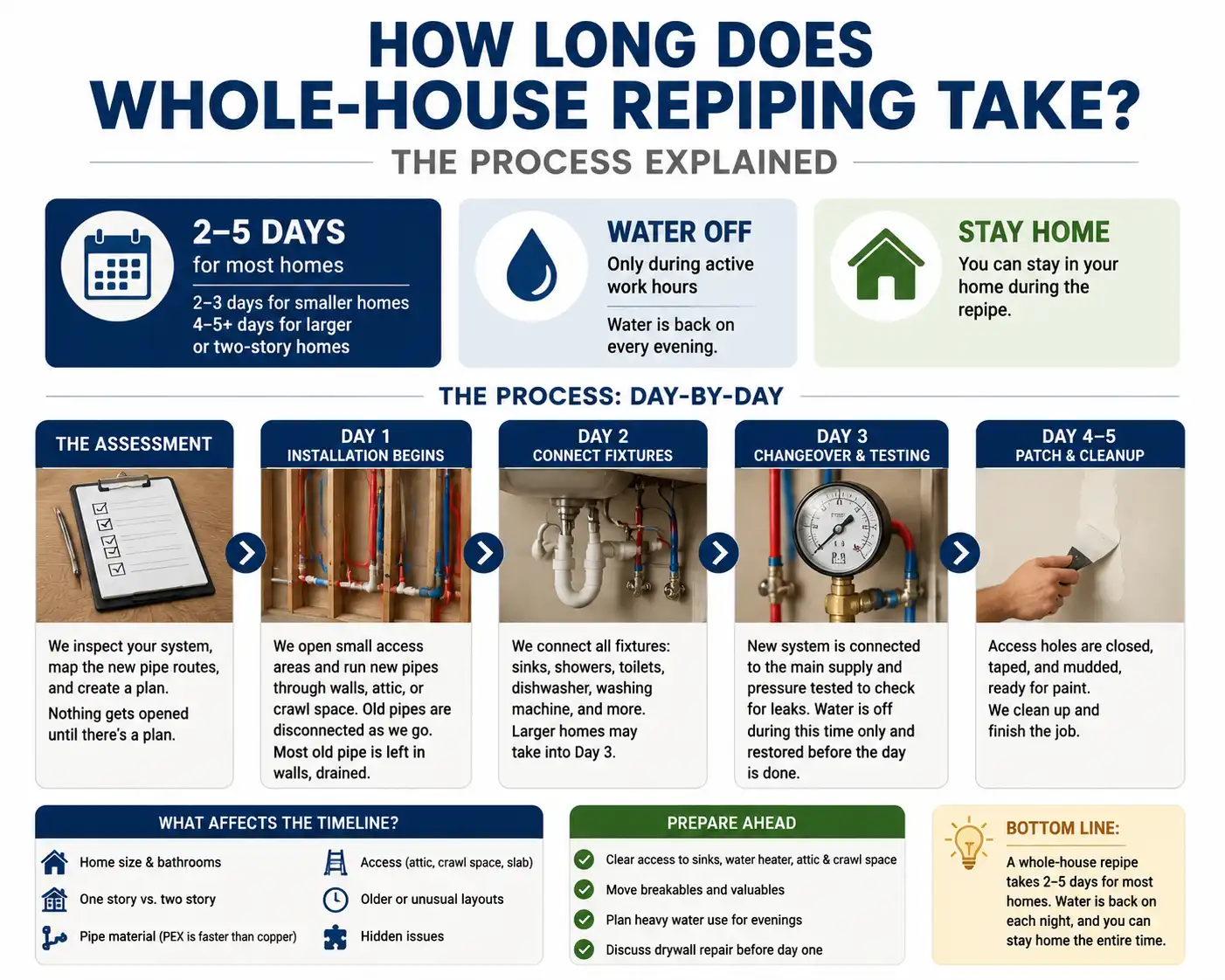
For most homes, a whole-house repipe takes two to five days. A small single story house with one or two bathrooms often finishes in two to three days. A larger home with three or more bathrooms, or a two story layout, can run four to seven days. This post walks through why it takes that long, what happens each day, and how to make it go smoothly.
The short answer, with the honest version
You will see companies advertise one day repipes. For a small home with easy attic access and a full crew, a one day install is possible, with a return trip for wall patching. But be careful with that promise. A proper repipe includes pressure testing, permits and inspection, and drywall repair. When those steps get rushed or skipped to hit a one day headline, the result is more leaks in the first months, rougher wall patches, and surprise charges for the work that was left out. A steady two to five days with everything done right is the better value.
What affects the timeline
Every home is different. These are the things that move the number up or down:
- Home size and bathrooms. More fixtures means more connections and more time. Square footage and bathroom count drive most of the estimate.
- One story or two. A two story home adds time because pipes have to be routed between floors.
- Pipe material. PEX is faster than copper, often two to three days against four to five for the same house, because PEX uses flexible runs and crimp connections while copper needs a soldered joint at every fitting. See PEX vs copper for coastal South Carolina if you are still choosing.
- Foundation and access. A home with an accessible attic or crawl space is quickest. A slab foundation adds complexity because the lines have to run through walls and the attic.
- Older or unusual layouts. Homes with additions, odd plumbing routes, or hidden problems can take longer once the walls are open.
The process, day by day
Here is how a typical repipe unfolds.
The assessment. Before any work starts, a plumber inspects your system, maps the new pipe routes, and gives you a timeline you can plan around. Nothing gets opened up until there is a plan.
Day one, the heavy day. This is the most intensive part. The crew protects your floors and furniture, then opens small, controlled access holes in the walls and ceilings where new pipe needs to run. New water lines go in through the walls, attic, or crawl space. If you are switching from old galvanized steel or polybutylene, the old pipe is disconnected as the new line goes in. In most homes the old pipe is left in the walls, drained, rather than torn out, which keeps demolition down.
Connecting the fixtures. Every sink, shower, toilet, dishwasher, and washing machine is tied into the new system. On a larger home this rolls into a second day.
The changeover and testing. The new system is connected to the main supply and pressure tested to confirm there are no leaks. This is the only stage where your water is fully shut off, and a good crew restores water at the end of each working day so you are never without it overnight.
Patching and cleanup. The access holes are closed, taped, and mudded, left ready for paint. Some companies include this in the price and others treat it as an add on, so ask up front. Either way, you should not be left staring at open walls.
Will your water be off the whole time
No. This is the part that surprises people most. While the new pipes are being installed, the old system usually stays running. Your water is only shut off during the tie in and during active work hours, commonly around eight to ten hours a day, and it is turned back on each evening. You have water every night.
Do you have to move out
Almost never. Most homeowners stay in the home through the entire repipe. There is noise and some dust, and a few hours a day without water during active work, but there is no reason to book a hotel for a standard job.
How to prepare
A little prep helps the crew move faster:
- Clear access to areas where pipes run: under sinks, around the water heater, and the attic or crawl space entry.
- Move breakables and valuables out of the work areas.
- Plan your heavy water use, like laundry, for the evenings when water is back on.
- Talk through the drywall repair before day one so you know what is included.
Related reading
- PEX vs Copper Piping: Which Is Best for Coastal South Carolina?
- Polybutylene Pipes in Goose Creek: Identification, Risks, Replacement
The bottom line
A whole-house repipe is not the weeks long ordeal people imagine. For most Goose Creek area homes it is a two to five day project, your water is back on every evening, and you stay in your home the whole time. The pipe you choose and the size of your home set the exact length, and a good plumber will give you a realistic day-by-day plan before starting. Learn more about our whole-house repiping service.
If you are facing a repipe in Goose Creek, Hanahan, North Charleston, Summerville, or the greater Charleston area, Mueller’s Plumbing Service will inspect your system, give you a clear timeline, and do the work with your water back on each night. Call us at (843) 572-8522 to schedule an evaluation.