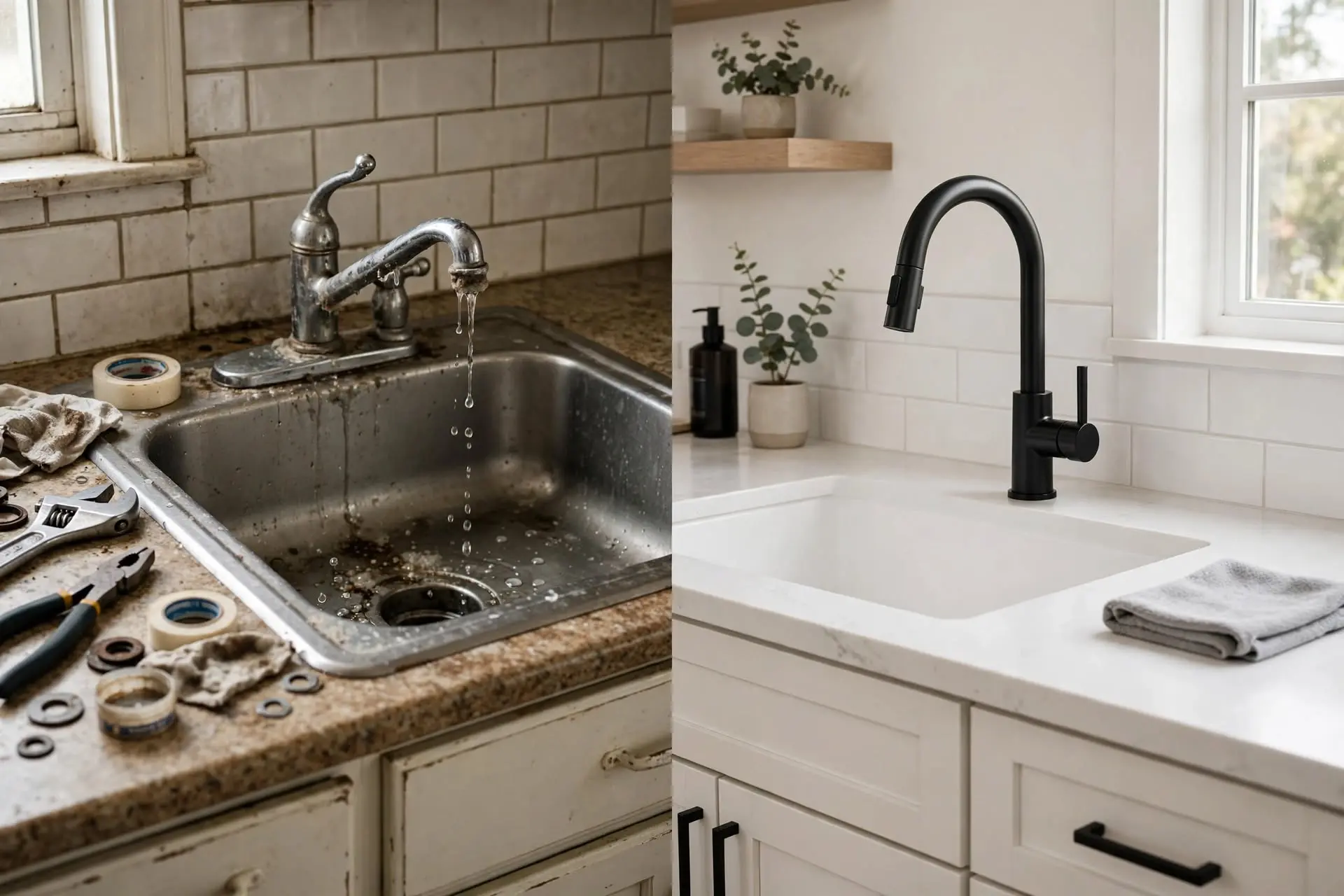
A dripping faucet feels like a repair job. Pull out the old cartridge, put in a new one, and the problem is solved. That logic holds in many cases. But there are situations where the cost of repairing a faucet adds up faster than the cost of replacing it would have, and homeowners who’ve replaced the same cartridge twice in three years know exactly what that feels like.
The decision between repair and replacement isn’t just about the immediate cost of parts. It’s about what the faucet is likely to cost over the next few years, how long parts will remain available for it, and what the condition of the fixture itself tells you about where it’s headed.
When Repair Makes Sense
Repairing a faucet is the right call in several situations.
The faucet is relatively new. A faucet installed within the last five to eight years with a single, identifiable failure is almost always worth repairing. The body of the fixture is in good shape, parts are available, and the repair restores full function without requiring new supply line connections or countertop work.
The failure is contained. A worn cartridge, a cracked O-ring, or a faulty seat washer are localized problems with straightforward fixes. If the drip is coming from a single point and the rest of the faucet operates normally, replacing the one component that failed is the efficient solution.
The faucet is a quality brand with parts availability. Major brands like Moen, Delta, Kohler, and Pfister manufacture replacement cartridges and internal components that are widely stocked. A repair on a well-made faucet from a major manufacturer is reliable and the parts are easy to source.
When Replacement Makes More Sense
The Faucet Is More Than 15 Years Old
Faucets don’t last forever, and the internal components of an older faucet often wear down in sequence rather than all at once. Replacing the cartridge on a 15-year-old faucet may solve the immediate drip but leave a fixture with worn O-rings, a corroded valve seat, and a spray diverter that’s already borderline. The next repair is usually not far behind the first.
At that age and beyond, the cost of two or three repairs over two years often exceeds the cost of a new faucet, installed and warranted. Replacement also gives you a fixture with a fresh warranty and parts that will be available for years to come.
Parts Are No Longer Available
Faucet manufacturers discontinue product lines, and when a line is discontinued, replacement parts eventually disappear from stock. A repair on a faucet with no available cartridge becomes a creative workaround rather than a real fix. Generic replacement parts rarely match the original tolerances and often fail sooner than the part they replaced.
If a faucet model has been out of production for several years, replacement is almost always the more reliable outcome.
The Body of the Faucet Is Damaged
Cracks in the faucet body, a finish that’s corroded through to the metal underneath, or a spout that moves when it shouldn’t are structural issues that a cartridge replacement won’t resolve. A leaking faucet with a compromised body needs to come out. Putting a new cartridge into a damaged fixture just delays the replacement by a few months.
The Leak Is at the Base
A faucet that drips from its base, where it meets the sink surface, usually has a failed O-ring inside the faucet body near the base. Fixing it requires removing the faucet, disassembling the body, replacing the O-ring, and reinstalling. On an older faucet, the labor cost of that repair comes close to the cost of installing a new fixture. At that point, putting that labor into a replacement rather than a repair is the better investment.
The Cost Comparison in Real Terms
Here’s how the math tends to work in Goose Creek homes.
A cartridge replacement on a straightforward single-handle faucet runs roughly $150 to $250 for parts and a plumber’s time. A new faucet installation on an existing setup, using a customer-supplied faucet, typically runs $200 to $400 depending on the configuration.
If a faucet needs its cartridge replaced once, repair is clearly cheaper. If it needs repair a second time within a year or two, the total cost of the two repairs approaches or exceeds the cost of replacement. If it needs repair a third time, the homeowner has paid more to maintain a failing fixture than a new one would have cost.
The calculation shifts further toward replacement when the faucet is old enough that the next repair after this one is likely to involve a different component.
What the Installation Involves
Faucet replacement in an existing setup is usually a single-visit job for a licensed plumber. The old faucet is disconnected from the supply lines, the mounting hardware is removed, and the new faucet is installed, sealed, and connected. The plumber tests for leaks at every connection before leaving.
In Goose Creek homes with older plumbing, the supply lines feeding the faucet are often worth replacing at the same time. Older braided rubber supply lines degrade and are a common source of under-sink leaks. Replacing them during a faucet installation adds minimal cost and removes a failure point that would otherwise require a separate visit later.
Choosing the Replacement Faucet
The faucet choice matters as much as the installation decision. Sticking with a major brand from a reputable manufacturer ensures that cartridges and parts remain available for years. The finish should match what’s already in the kitchen or bathroom unless a full fixture update is planned.
For kitchen faucets, confirm the number of mounting holes in the sink before selecting a faucet. Single-hole, three-hole, and four-hole configurations require different faucet types. A plumber can confirm the configuration during the assessment and identify any adapter requirements before the faucet is purchased.
The repair-versus-replace decision on a faucet is worth thinking through once before defaulting to whichever option feels smaller. In Goose Creek homes where the plumbing is aging alongside the fixture, replacement often turns out to be the decision that costs less over the next three years.