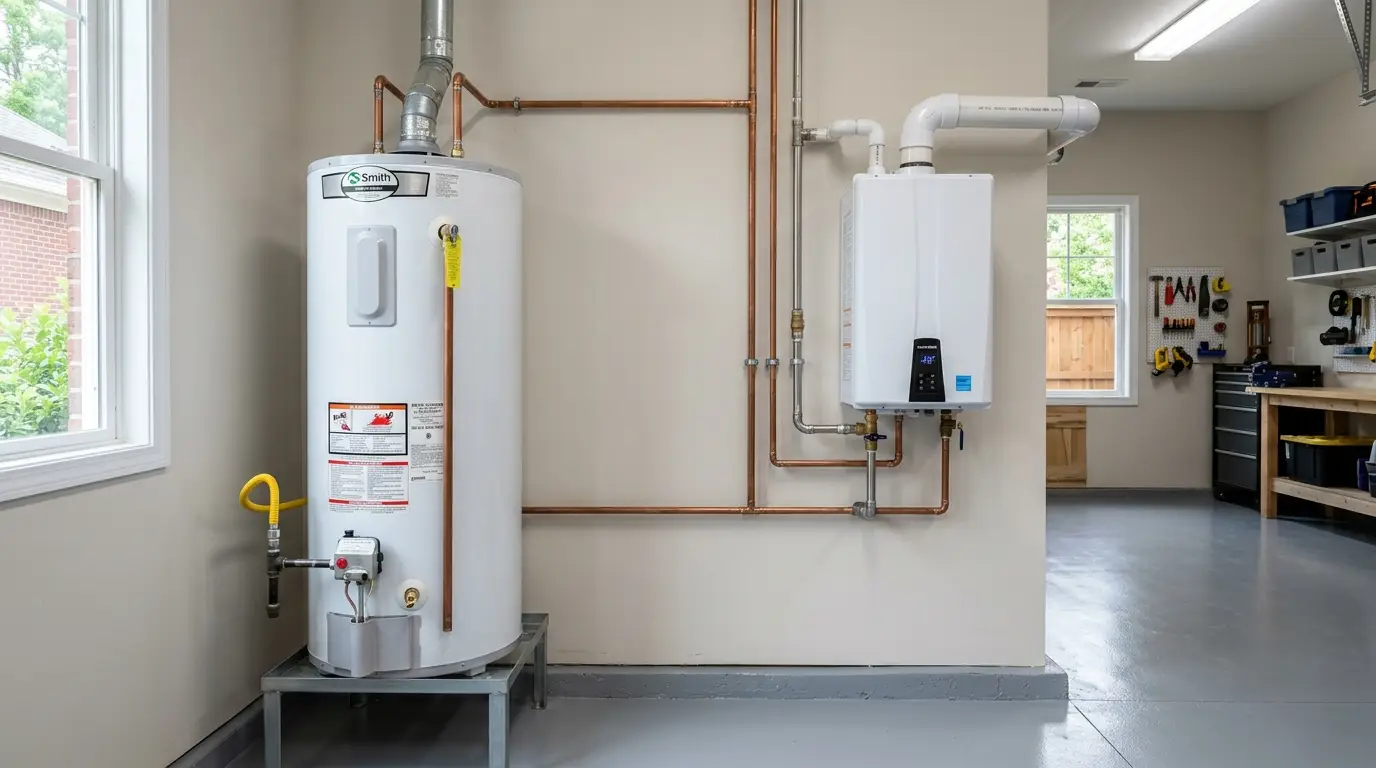
The question of tank versus tankless comes up every time a water heater needs to be replaced in Goose Creek, and the answer is rarely as simple as one being better than the other. Both systems work well when they’re sized and installed correctly. Both underperform when they’re not matched to the home they’re in.
This guide looks at how each system performs in the specific conditions of a Lowcountry home, what the honest tradeoffs are, and how to think through the decision before committing to either option.
How Each System Works
Knowing the basic difference helps frame everything that follows.
A tank water heater stores a fixed volume of hot water, typically 40 to 80 gallons, and maintains that water at a set temperature around the clock. When you draw hot water, the stored supply depletes and the tank refills and reheats. The limitation is that a tank can run cold if demand exceeds the stored volume. The advantage is that it delivers hot water instantly because the supply is already heated and waiting.
A tankless water heater heats water on demand as it flows through the unit. There’s no stored supply, which means there’s no risk of running out during back-to-back showers. The limitation is that a tankless unit can only heat water at a certain rate, measured in gallons per minute, and if demand exceeds that rate, the output temperature drops or the unit struggles to keep up.
What the Lowcountry Climate Means for Water Heater Performance
One factor that’s specific to this area is incoming groundwater temperature. In colder climates, groundwater enters the home at temperatures that can be 40 degrees Fahrenheit or lower in winter. The water heater has to raise that water significantly to reach the desired output temperature.
In Goose Creek and the surrounding area, groundwater temperatures are warmer year-round, typically in the 60s Fahrenheit. This matters more for tankless units than for tanks. A tankless water heater is sized based partly on how much it needs to raise the incoming water temperature. In a cold climate, a larger unit is needed to achieve the same output. In the Lowcountry, a smaller, less expensive tankless unit can handle the same demand because the starting temperature of the water is already higher.
This is one reason tankless systems tend to perform well in South Carolina homes. The lower temperature rise required means the unit isn’t constantly running at its upper capacity limit.
The Tank Case
Tank water heaters still make sense for a lot of Goose Creek homes, and the reasons are worth knowing rather than dismissing.
The upfront cost of a tank replacement is lower than tankless installation. A standard 50-gallon gas tank replacement, including installation, runs considerably less than a tankless installation that may also require gas line upgrades and new venting. For homeowners who aren’t planning to stay in the home long-term or who have a tight replacement budget, the lower upfront cost of a tank is a real advantage.
Tank units are also simpler to maintain. Annual flushing to clear sediment and periodic anode rod inspection are the main tasks. There are no flow sensors, no heat exchangers to descale, and no error codes to diagnose. When a tank heater fails, the problem is usually identifiable and the fix is often straightforward.
For households with lower hot water demand, a tank is also a reasonable long-term choice. A couple living in a home with a 40-gallon tank is unlikely to run out of hot water under normal usage patterns, and the energy cost of maintaining a smaller tank at temperature is modest.
The Tankless Case
Tankless water heaters suit Goose Creek homes well for several reasons, and the advantages go beyond marketing claims about endless hot water.
The longer lifespan is the most significant practical advantage. A properly maintained tankless unit commonly lasts 20 years or more. A tank heater in the same conditions averages 10 to 12 years. Over a 20-year period, a homeowner with a tank heater is likely to replace the unit twice. A homeowner with a properly installed tankless unit typically replaces it once, if at all, over the same period. The higher upfront cost of tankless looks different when viewed over that timeline.
Energy efficiency is a real benefit, not just a selling point. A tank heater keeps 40 to 80 gallons of water hot around the clock regardless of demand. A tankless unit only consumes energy when hot water is actually being drawn. The difference in operating cost over the course of a year is meaningful for households with moderate to high hot water usage.
The gas line requirement is worth knowing about before committing to tankless. Most tankless gas units require a larger gas line than what a tank heater uses. In older Goose Creek homes, the existing gas line may need to be upgraded to supply adequate flow to the unit. This adds to the installation cost and is a step that needs to be assessed during the consultation, not after the unit is purchased.
Sizing Is Everything
The most common mistake with both systems is choosing the wrong size for the household.
For tanks, undersizing means running cold. A family of four consistently running out of hot water with a 40-gallon tank needs a 50 or 60-gallon unit, not a longer recovery time on the same tank.
For tankless, undersizing means temperature drop. A tankless unit that’s rated for two gallons per minute will struggle if a shower and a dishwasher are running simultaneously. The correct sizing calculation looks at the maximum simultaneous demand, not the average.
A plumber who assesses the home before recommending a unit will ask about household size, simultaneous usage patterns, and the existing gas line or electrical supply. That assessment, done before a unit is selected, is what produces a system that actually performs the way it’s supposed to.
The Straightforward Answer
Tank heaters suit homes where upfront cost matters, hot water demand is moderate, and simplicity of maintenance is a priority. Tankless suits homes where long-term value, energy efficiency, and continuous hot water supply are the priorities, and where the installation can be done correctly with the right gas line and venting in place.
In the Lowcountry, the warmer groundwater temperature works in tankless’s favor. But the right answer for any specific home depends on the household, the existing infrastructure, and how long the homeowner plans to stay.