Low water pressure is one of those problems that seems minor until it isn’t. A shower that barely rinses shampoo out properly, a faucet that fills a pot at a trickle, or a washing machine that takes twice as long to fill are all daily annoyances with real causes. The good news is that most low water pressure problems in Goose Creek homes come from one of a handful of sources, and knowing which one you’re dealing with is the first step toward fixing it.
This guide walks through the most common causes of low water pressure, how to tell them apart, and when the problem calls for a plumber rather than a trip to the hardware store.
Start with the Simplest Explanation First
Before assuming there’s a plumbing problem, it’s worth ruling out the most straightforward causes.
Check If It’s One Fixture or All of Them
Turn on faucets in different rooms and run the shower at the same time. If the low pressure is limited to one faucet or one bathroom, the problem is local to that fixture. If every fixture in the house is running weak, the problem is somewhere in the main supply coming in.
Check the Main Shutoff Valve
The main shutoff valve is typically located where the water line enters the home, near the foundation or in a utility area. If it was recently turned off for any reason and not opened fully afterward, it will restrict flow throughout the entire house. A ball valve should have the handle parallel to the pipe to be fully open. A gate valve should be turned counterclockwise until it stops.
Ask Your Neighbors
If two or three neighbors are experiencing the same issue at the same time, the problem is almost certainly with the municipal supply rather than your home’s plumbing. Contact the utility company before spending time or money investigating internally.
When It’s a Fixture Problem
Single-fixture low pressure is almost always a local issue that doesn’t require a plumber.
Clogged Aerators
The aerator is the small screen at the tip of a faucet. Over time, mineral deposits from hard water accumulate on it and block flow. Unscrewing the aerator, rinsing it under water, and scrubbing off the buildup with a small brush restores full pressure in minutes. If the aerator is badly corroded, replacing it costs a couple of dollars at any hardware store.
Showerhead Buildup
Showerheads accumulate the same mineral deposits that affect aerators, but the buildup happens inside the nozzle holes rather than on a screen. Soaking the showerhead in white vinegar overnight dissolves most of the deposits. If the showerhead is old and the buildup is heavy, replacing it is a low-cost fix.
Worn Cartridge or Valve
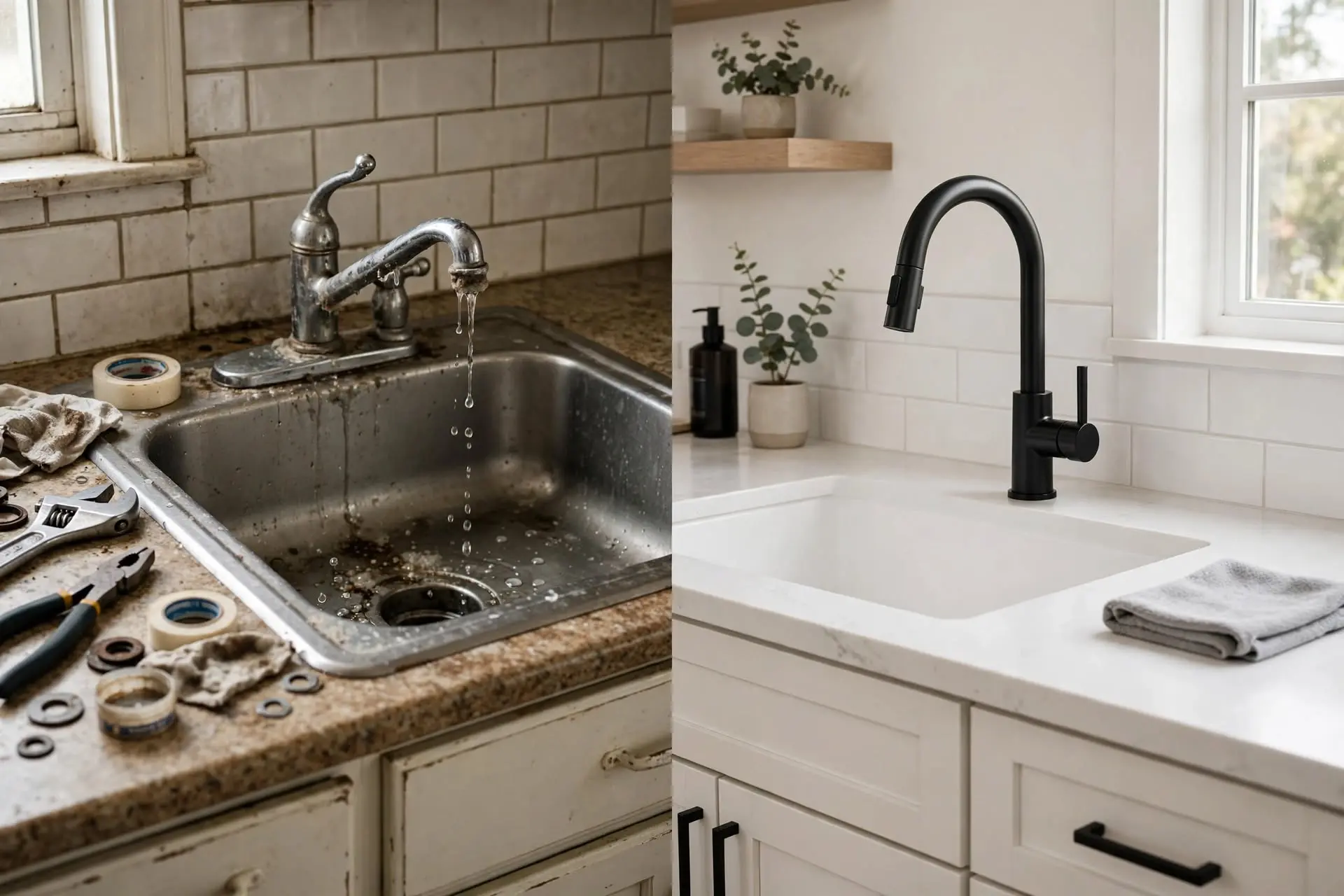
A single-handle faucet uses a cartridge to control both temperature and flow volume. When the cartridge wears out, it may restrict flow even when the handle is fully open. Cartridge replacement is a straightforward repair but does require shutting off the supply to that fixture and opening the valve body.
When It’s a Pressure Regulator Problem
Homes with city water often have a pressure reducing valve, or PRV, installed where the main water line enters the house. This valve reduces the high incoming pressure from the municipal main down to a safe range for residential plumbing, typically 50 to 70 PSI.
When the PRV fails or wears out, it can restrict flow below its set point rather than simply reducing it to the correct level. This causes whole-house low pressure that gets gradually worse over time. PRVs typically last 10 to 15 years, so any home where the valve hasn’t been inspected in a decade is worth having checked.
A pressure gauge attached to an outdoor hose bib while no fixtures are running will give you the incoming static pressure reading. If it reads below 40 PSI and your PRV is more than 10 years old, the valve is the likely culprit.
When It’s a Pipe Problem
Older homes in Goose Creek with original galvanized steel supply pipes face a specific kind of low pressure problem. Galvanized steel corrodes from the inside out, and that corrosion layer builds up on the pipe walls over decades. A pipe that was installed at full diameter 40 or 50 years ago may now have an interior that’s half the size it started as.
This kind of pressure loss develops slowly, which is why homeowners often attribute it to something else or simply get used to it over time. The pressure doesn’t drop overnight. It gets a little worse each year until it becomes noticeable.
The diagnostic test here is straightforward. If the home has galvanized steel pipes and has never been repiped, and the low pressure affects the whole house rather than a single fixture, corroded pipes are almost certainly contributing to the problem.
Partial repiping in the most affected sections can restore pressure significantly. Full repiping with PEX or copper eliminates the problem entirely and removes the ongoing risk of leaks from pipes that are already near the end of their service life.
When It’s a Leak in the Supply Line
A leak in the main water service line, the pipe that runs from the meter to the house, diverts water before it reaches any fixture. The result is reduced pressure across the entire home, combined with water going somewhere it shouldn’t.
Signs that a supply line leak is the cause include a water bill that jumped without a change in usage, a wet or soft spot in the yard directly over where the service line runs, and a water meter that continues moving after every fixture in the home is shut off.
If the meter is still moving when everything is off, there is a leak somewhere between the meter and the home. That section of pipe is the homeowner’s responsibility, and the repair should be made quickly to avoid wasting water and to prevent soil erosion around the line.
When to Call a Plumber
DIY checks cover a lot of ground, but there are situations where professional diagnosis is the right call.
Whole-house low pressure that persists after the main shutoff is confirmed fully open, the PRV has been checked, and the neighbor test rules out a municipal issue points to either a failing PRV, corroded pipes, or a supply line problem. All three require a licensed plumber to assess and repair correctly.
A pressure test using the right equipment gives a clear reading at multiple points throughout the system, which narrows down exactly where the pressure is being lost. From there, the repair approach becomes clear: PRV replacement, partial or full repiping, or supply line repair.
Low water pressure in Goose Creek homes is a fixable problem. The key is identifying the right cause before spending money on the wrong solution.