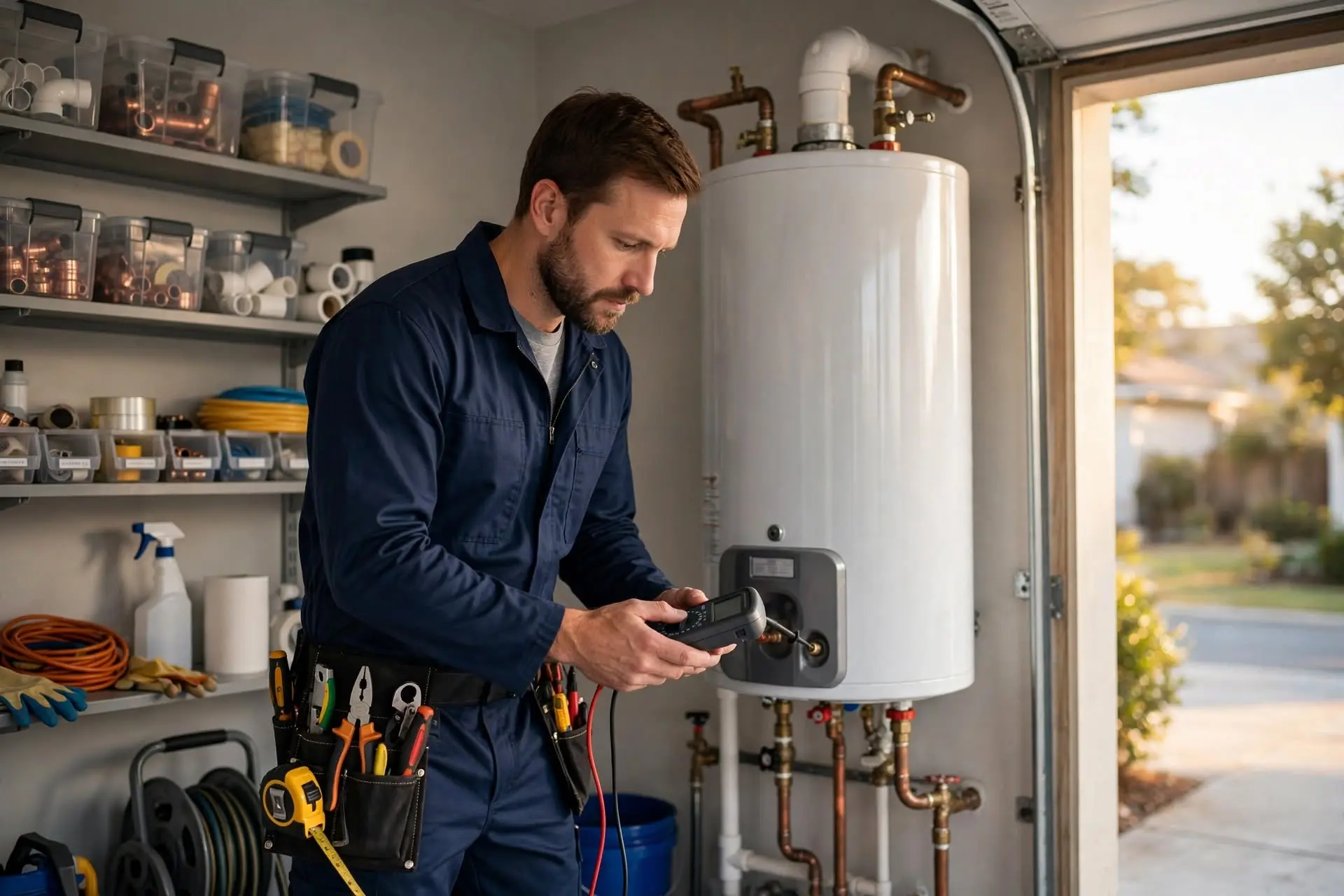
Walk into any big box store and tell them you need a new water heater. The first question they ask is always the same: how many gallons? Most homeowners answer based on what they had before, or they guess. This is how Goose Creek homes end up with water heaters that are either too small (cold showers when two people shower back to back) or too large (wasting hundreds of dollars a year heating water nobody uses).
This article replaces guessing with actual sizing math. You will learn how to calculate your home’s real hot water demand, understand the difference between tank size and FHR (the spec that actually matters), and match your household profile to the right size tank or tankless unit without over-buying or under-sizing.
FHR: The Spec That Actually Matters (Not Just Gallons)
Here is what most homeowners miss. The gallon number on a water heater tells you the tank capacity. It does NOT tell you how much hot water the unit can deliver in the hour when your family needs it most. That second number is called the First Hour Rating (FHR), and it is the most important specification on any water heater you buy.
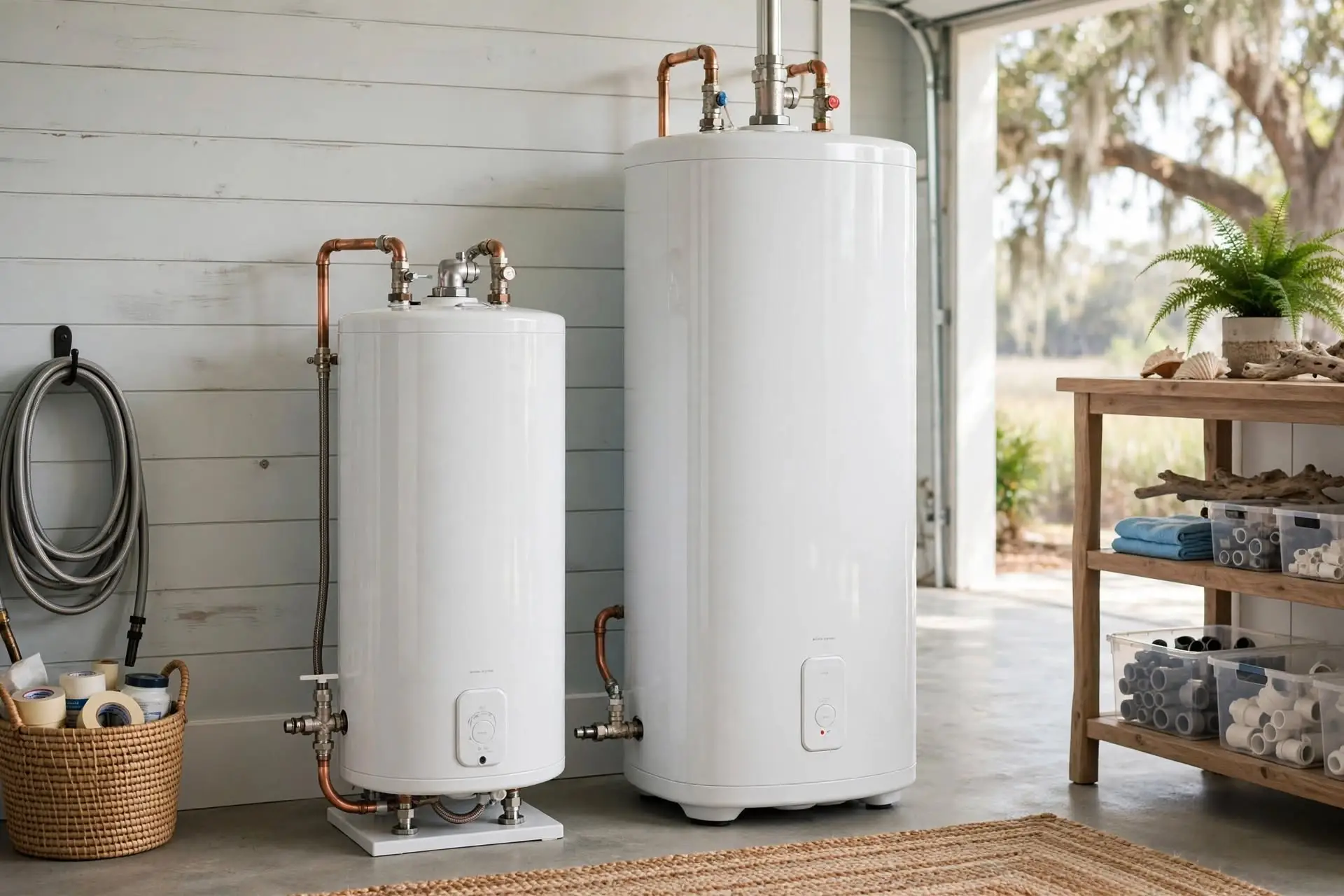
FHR measures how many gallons of hot water the unit can provide during its first hour of operation from a fully heated tank. It combines tank capacity PLUS recovery rate (how fast the unit reheats water while you are using it). A 50-gallon tank with a slow recovery rate might only have an FHR of 55. A 40-gallon tank with fast recovery could have an FHR of 70. The smaller tank would actually serve your family better during peak demand.
Where to Find the FHR
The FHR is printed on the yellow EnergyGuide label on every water heater sold in the US. Look for ‘First Hour Rating’ followed by a gallon number. This is what you should match to your household’s peak demand, not just the tank size. A water heater without an FHR posted is either very old equipment or commercial-grade and should not be in residential consideration without specific advice.
Calculate Your Household’s Peak Hour Demand
Peak hour is the 60-minute window when your household uses the most hot water, typically weekday mornings between 6:30 and 8:00 AM in most Goose Creek homes. This is when you are most likely to run out of hot water if your water heater is undersized.
The Quick Peak Hour Calculation
- List every hot water activity that happens during your busiest hour
- Multiply each activity by its typical hot water use (table below)
- Add up the total gallons of hot water needed
- Match your total to the FHR of candidate water heaters (your FHR should equal or exceed peak hour demand)
Typical Hot Water Use by Fixture
| Fixture | Hot Water per Use | Notes for Sizing |
| Standard shower (8 minutes) | 17-25 gallons | Biggest daily demand driver |
| Luxury shower (10+ min, rainfall) | 25-40 gallons | Premium fixtures use 50% more |
| Bathtub (standard soak) | 20-30 gallons | Deep tubs: 40-60 gallons |
| Dishwasher cycle | 6-10 gallons | Modern units use less |
| Clothes washer (warm/hot) | 15-30 gallons | Depends on cycle/load size |
| Bathroom sink use (handwashing) | 1-2 gallons | Minimal impact |
| Kitchen sink (dishes by hand) | 4-6 gallons | Moderate impact |
Example: Family of 4 Morning Peak
Two adults shower (2 x 20 gallons = 40), two kids share a bath (30 gallons), dishwasher runs (8 gallons), clothes washer runs warm (20 gallons). Total peak hour demand: 98 gallons. This family needs an FHR of at least 100, which typically means a 50-gallon tank with high recovery or a 75-gallon standard tank.
Quick Household-to-Size Matching Table
If you do not want to run the peak hour math for your specific home, here are tested pairings that work for most Goose Creek homes. These are starting points, not absolutes. Your actual needs may shift if you have unusual fixtures or usage patterns.
| Household Profile | Peak Hour Usage | Tank Size | FHR Target |
| 1 person, small condo | 20-30 gallons | 30-40 gallon | 45-55 gal |
| 2 adults, no kids | 35-50 gallons | 40-50 gallon | 55-70 gal |
| Family of 3 (2 adults + 1 child) | 50-65 gallons | 50 gallon | 65-75 gal |
| Family of 4 (2 adults + 2 kids) | 65-85 gallons | 50-60 gallon | 75-85 gal |
| Family of 5 (2 adults + 3 kids) | 85-110 gallons | 60-75 gallon | 85-100 gal |
| Family of 6+ or multi-gen home | 110-150+ gallons | 75-80 gallon or tankless | 100+ gal |
| Luxury home (large tubs, body sprays) | Add 20-30 gallons to base | Upsize 1 tier | Add 20-30 gal |
Use this as your baseline, then adjust up if you have large soaking tubs, multiple teenage showers, rain-style showerheads, or back-to-back hot water demand patterns common in Goose Creek families with school-age kids.
Recovery Rate: Why Two 50-Gallon Heaters Are Not Equal
Recovery rate is how quickly a water heater reheats water as it is being used. It is measured in gallons-per-hour that can be heated from cold supply to output temperature. Electric water heaters typically have slower recovery rates (20 to 25 GPH), while gas water heaters recover much faster (40 to 50 GPH). This is why a 40-gallon gas tank often outperforms a 50-gallon electric tank in real-world use.
In Goose Creek where many homes have multiple bathrooms in continuous use during morning peak, recovery rate matters as much as tank size. A fast-recovery gas unit can handle sustained demand better than a slow-recovery electric unit of identical tank size. Always check both specifications when comparing models.
Tankless Sizing Works Completely Differently
Tankless water heaters are sized by GPM (gallons per minute) flow rate, not tank gallons. There is no tank to fill. The unit heats water as it flows through, and the maximum flow rate determines how many fixtures can run simultaneously with hot water.
Typical tankless sizing: 4-6 GPM handles 1-2 simultaneous fixtures (small home or small family), 7-9 GPM handles 2-3 simultaneous fixtures (most 3-4 bedroom homes), 10+ GPM handles 3-4 simultaneous fixtures (large homes with multiple bathrooms in concurrent use). Goose Creek’s incoming water temperature of 65-75 degrees (depending on season) means your tankless unit needs to raise water temperature about 45-55 degrees to reach a comfortable shower temp. Colder incoming water reduces the effective GPM output of any tankless unit.
Tankless sizing depends heavily on whether tankless is actually the right choice for your household. Our detailed guide on tankless water heater pros and cons for Goose Creek homeowners covers whether tankless is the right fit and the lifestyle tradeoffs that tank buyers never have to think about.
Common Sizing Mistakes in Goose Creek Homes
Here are the sizing errors we see repeatedly, and what they cost homeowners.
Mistake 1: Matching Size to the Old Heater
Many homeowners replace a 40-gallon heater with a new 40-gallon heater because that is what was there before. But the old heater might have been undersized from the start, or your family size has changed, or your fixtures are newer and use different amounts of water. Always recalculate rather than auto-matching the old size.
Mistake 2: Buying the Biggest Tank You Can Fit
An oversized water heater wastes energy every hour of every day, whether you use the hot water or not. A 75-gallon tank in a 2-person household costs $150 to $300 per year more to run than an appropriately sized 40-gallon tank. Over 12 years, that is $1,800 to $3,600 wasted. Bigger is not better. Right-sized is better.
Mistake 3: Ignoring Recovery Rate
Two 50-gallon water heaters with dramatically different recovery rates will perform very differently. Homeowners buying electric in a gas-capable home often run out of hot water despite having ‘enough’ tank capacity, because the recovery rate cannot keep up with sustained demand.
Mistake 4: Not Accounting for Luxury Fixtures
Large soaking tubs, rainfall showerheads, body sprays, and multiple showerheads in one bathroom change the math dramatically. A rainfall showerhead alone uses 50 percent more hot water than a standard showerhead. If you have premium fixtures, upsize by one tier or run the exact peak hour calculation.
Get Right-Sized Water Heater Recommendations
Water heater sizing affects everything from your monthly energy bill to whether someone gets a cold shower at the worst possible moment. Mueller’s Plumbing Service provides sizing consultations for Goose Creek homeowners, including walkthrough of your current fixtures, peak hour demand calculation, recovery rate matching, and written recommendations with specific models that fit your actual use pattern, not a generic guess.
Call us at (843) 572-8522, or visit our water heater installation service page to schedule a sizing consultation. After 30 years of water heater installations in the Tri-County area, we know which sizes work for which homes, and we help Goose Creek homeowners avoid the sizing errors that lead to cold showers or sky-high energy bills.