There is a common belief among South Carolina homeowners that burst pipes are a Northern problem. Midwest winters burst pipes. Maine winters burst pipes. Goose Creek? Not really, right? It rarely freezes, and when it does, it is just for a night or two. This belief is comforting, and it is also wrong. Pipes burst in South Carolina homes every year, often in ways that have nothing to do with the temperature on the day they failed.
This article covers three SC-specific reasons pipes burst that most Goose Creek homeowners never think about until it happens to them. Understanding these reasons is the first step to preventing the kind of burst pipe emergency that turns into a $10,000 water damage job overnight.
The Truth About SC Climate and Burst Pipes
South Carolina homes face climate conditions that actually cause MORE burst pipe damage per incident than Northern climates, not less. The reason is simple. Northern homes are built and maintained for extreme cold. Pipes are insulated, routed through warm interior spaces, and homeowners expect to take freeze precautions every winter. SC homes are built for warm weather, so when an unexpected cold snap hits, pipes are exposed, uninsulated, and running through crawl spaces that stay 15 to 20 degrees colder than the main living area.
| Climate Factor | SC Impact on Pipes | Why Homeowners Miss It |
| Year-round humidity (70-85%) | Accelerates pipe corrosion 2-3x faster than dry climates | Damage happens silently over years, not days |
| Infrequent sub-freezing events | Pipes unprotected when 1-3 hard freezes hit annually | No winter-prep culture like Northern states |
| Sudden temp drops (50°F to 20°F in hours) | Thermal shock cracks aged fittings instantly | Temperature change, not cold itself, does the damage |
| Heavy rainfall + coastal salt air | Exterior pipes pit and weaken faster | Hidden under crawl spaces and slab foundations |
| Long hot summers (90°F+ sustained) | Expansion cycles stress old pipes, loosen joints | No visible damage until failure point reached |
The combination of humidity, infrequent-but-severe cold snaps, and construction styles designed for heat (not cold) makes SC pipes more vulnerable to bursting than many homeowners realize. Here are the three specific reasons most homeowners do not see coming.
Reason 1: Humidity Is Quietly Corroding Your Pipes Every Day
Coastal South Carolina’s average humidity runs 70 to 85 percent year-round. That moisture does not just make the summers uncomfortable. It is actively corroding the pipes inside your walls, under your crawl space, and around your water heater every single day. Over 10 to 20 years, this silent damage weakens pipes to the point where a minor pressure spike or small temperature change causes them to burst.
How Humidity Damages Pipes From the Outside In
Most burst pipe discussions focus on what happens INSIDE the pipe (water freezing, pressure building up, fittings failing). SC’s humidity problem works in reverse. It damages pipes from the OUTSIDE. Condensation forms on cold water lines every time warm humid air meets a cool pipe surface. That moisture drips onto the pipe itself, onto fittings, onto the wood and insulation around the pipes.
Over years, this constant moisture exposure causes galvanic corrosion at fitting joints, pitting on copper pipe exteriors, rust on metal clamps and brackets, and gradual weakening of pipe walls. The pipe that looks fine on the outside might have lost 30 percent of its wall thickness without any visible warning. When stress finally hits (cold snap, pressure surge, hard water impact), the weakened pipe bursts at the corroded spot.
Why This Is Worse in Goose Creek Specifically
Goose Creek sits 15 miles inland from the coast, which sounds safer than oceanfront. In reality, the combination of coastal salt air carried inland by wind and the high humidity trapped in our low-elevation marshy terrain accelerates pipe corrosion more than typical coastal areas. Salt particles in the air bond with moisture and settle on exterior pipes, fittings, and water heater connections. This is why Goose Creek pipes age faster than expected.
Reason 2: Infrequent Cold Snaps Cause More Damage Than Regular Winters
Counterintuitively, the fact that SC rarely gets hard freezes is what makes our cold snaps so dangerous. When a cold snap finally does hit, three things work against Goose Creek homeowners that Northern homeowners never face.
First, there is no winter-prep culture. Homeowners in Minnesota winterize their pipes every October because they know it is coming. Goose Creek homeowners often go 2 or 3 winters without needing to think about pipes, then one year a polar vortex drops temperatures to 15 degrees overnight and nothing is prepared.
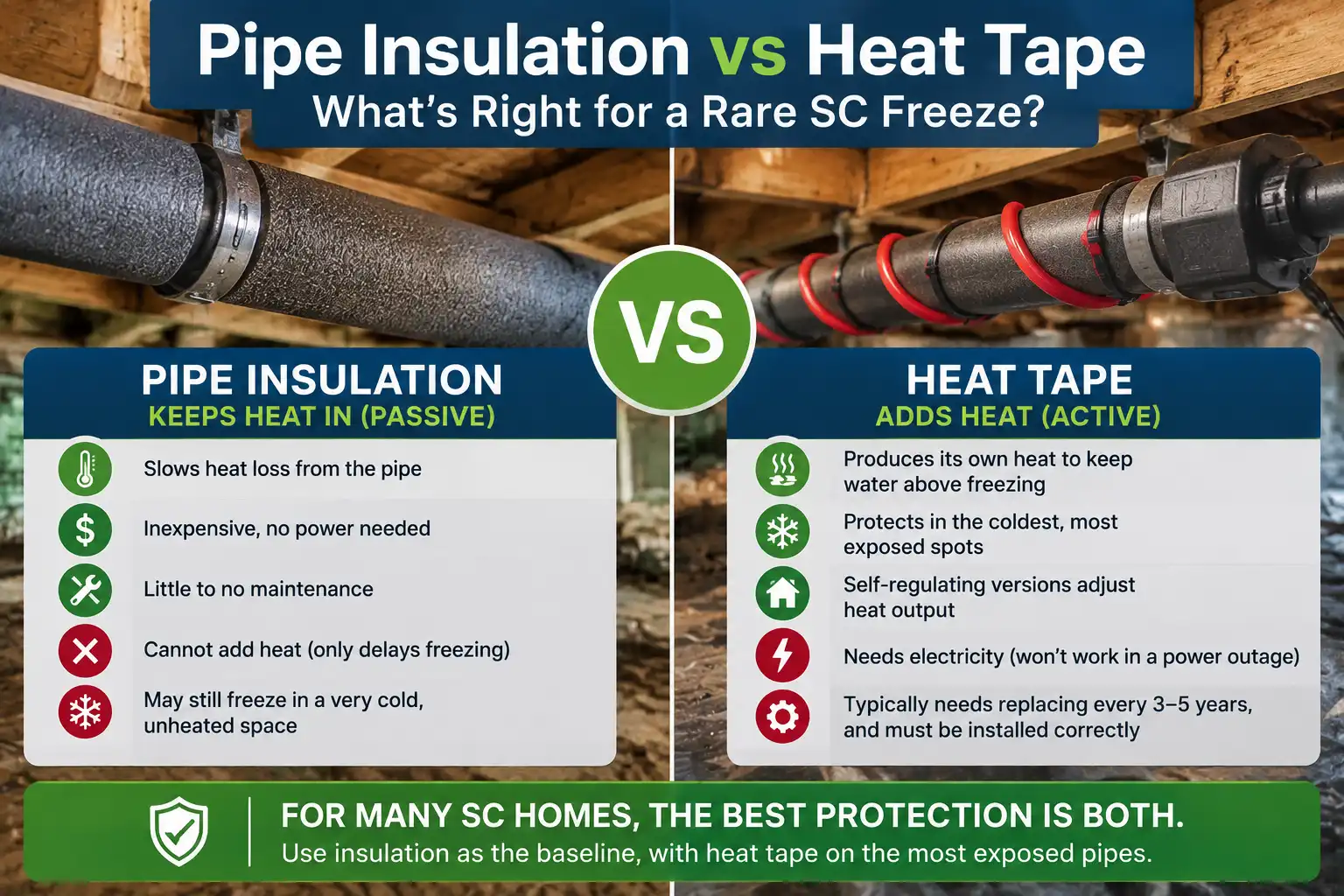
Second, SC home construction does not account for freezing. Pipes run through unheated crawl spaces, along exterior walls, through attics, and in garage ceilings. In Northern construction, these routes get insulation, heat tape, or interior routing. In SC construction, they are just run the shortest path because freezing was never expected.
Third, the temperature drops are often sudden. Goose Creek can go from 65 degrees during the day to 22 degrees overnight during a cold front. Pipes do not get a gradual cool-down that lets thermal contraction happen slowly. They get thermal shock that cracks aged fittings instantly. This is why you see reports of dozens of pipe bursts on the same night across the Tri-County area after a single hard freeze.
The 25 Degrees in 6 Hours Rule
A common pattern in SC burst pipe cases is a rapid temperature drop of 25 degrees or more within a 6-hour window. This thermal shock stresses every pipe in the home. Newer pipes handle it fine. Pipes that are 15+ years old, have corrosion at the joints, or are located in exposed areas often fail. The shock is not the cold itself. It is the speed of the change.
Reason 3: SC Construction Puts Pipes in Vulnerable Positions Northern Homes Do Not Have
South Carolina home construction has two features that northern homes rarely have, and both create burst pipe risks that surprise homeowners.
Crawl Space Exposure
Most Goose Creek homes are built over crawl spaces rather than basements. Crawl spaces get significantly colder than the living area during winter because they are essentially exterior space with minimal insulation. A home where the thermostat reads 68 degrees might have pipes under the floor sitting at 42 degrees during a cold snap. Add a 20-degree outside temperature overnight and those pipes are now at 32 degrees and freezing, while the homeowner thinks the house is perfectly warm.
Crawl space pipes also have limited air circulation, which means once they freeze, they stay frozen longer than expected. A cold snap that lasts 36 hours can keep crawl space pipes frozen for 48 to 60 hours even after outdoor temps rise above freezing.
Slab Foundation Pipes
Many Goose Creek homes built after 1980 sit on concrete slab foundations with water supply lines running through or under the concrete. Slab pipes are protected from freezing by the ground temperature, which rarely drops below 40 degrees. But they face a different burst risk entirely: concrete settling, soil shifting, and pressure spikes that stress pipe joints hidden in concrete.
When a slab pipe bursts, the homeowner often does not know for weeks. Water pools under the foundation, seeps up through the floor eventually, and by the time damage is visible, thousands of gallons have already been lost. Slab leaks and slab bursts are one of the most expensive plumbing failures in SC homes because detection and repair require specialized equipment.
What to Watch For in Your Goose Creek Home
Now that you know the three unexpected reasons, here are the specific warning signs that suggest your home is vulnerable to a burst pipe.
- Home is 20+ years old with original copper or galvanized pipes
- You have uninsulated pipes visible in the crawl space
- Water stains or condensation spots on exterior walls near pipe runs
- Green or white mineral buildup at pipe joints
- Water pressure varies noticeably between cold morning and warm afternoon
- Pipes run along exterior walls or through the garage ceiling
- Water bill jumps periodically without explanation (slow leaks precede bursts)
If two or more of these apply to your home, you are in the higher-risk category. Our complete guide to plumbing red flags Goose Creek homeowners should never ignore covers the broader warning signals beyond just burst pipe risks.
The Minimum Prevention Every SC Homeowner Should Do
You cannot prevent every burst pipe, but you can eliminate 80 percent of the risk with a few specific steps. These are the minimums for any Goose Creek homeowner concerned about burst pipes.
- Insulate all exposed pipes in crawl spaces and garages with foam sleeves
- Know exactly where your main water shutoff is and test it annually
- During cold snaps below 28 degrees, let both hot and cold faucets drip slightly
- Open cabinet doors under sinks on exterior walls during cold nights
- Have pipes professionally inspected every 5 years if your home is 20+ years old
- Address any slow leak within a week (slow leaks become bursts)
Get Your Pipes Assessed Before Burst Season Hits
The best time to find out your pipes are vulnerable is before a cold snap or pressure event exposes the weakness. Mueller’s Plumbing Service provides pipe condition assessments for Goose Creek homes, including visual inspection of accessible pipes, crawl space evaluation, pressure testing, and written reports on specific vulnerabilities. After 30 years of burst pipe repairs across the Tri-County area, we know where bursts happen and what homeowners can do to prevent them.
Call us at (843) 572-8522 for a pipe assessment or burst pipe repair service. The cost of prevention is always lower than the cost of cleanup, and knowing your vulnerabilities is how you avoid being the next homeowner dealing with a burst at 2am on the coldest night of the year.