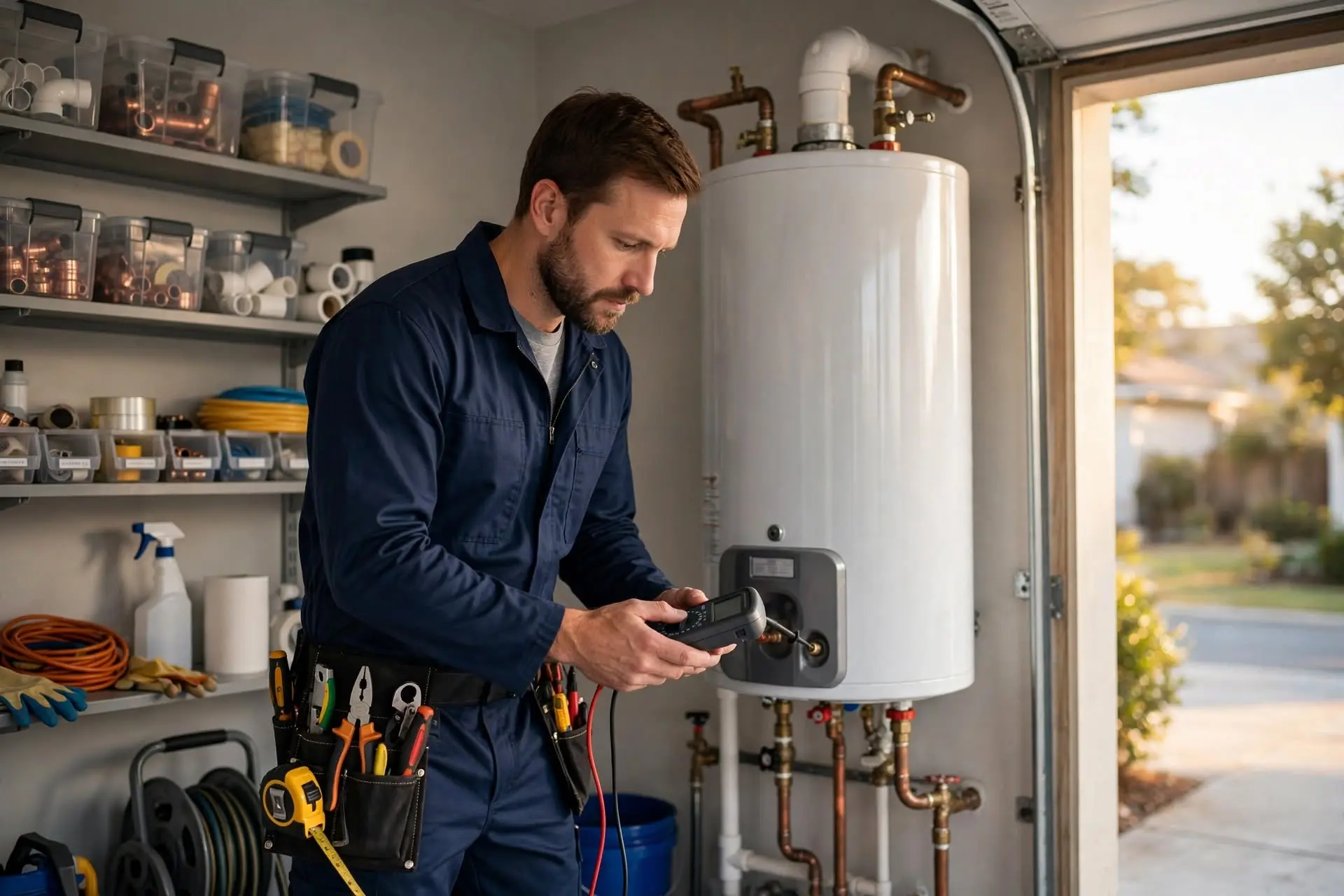
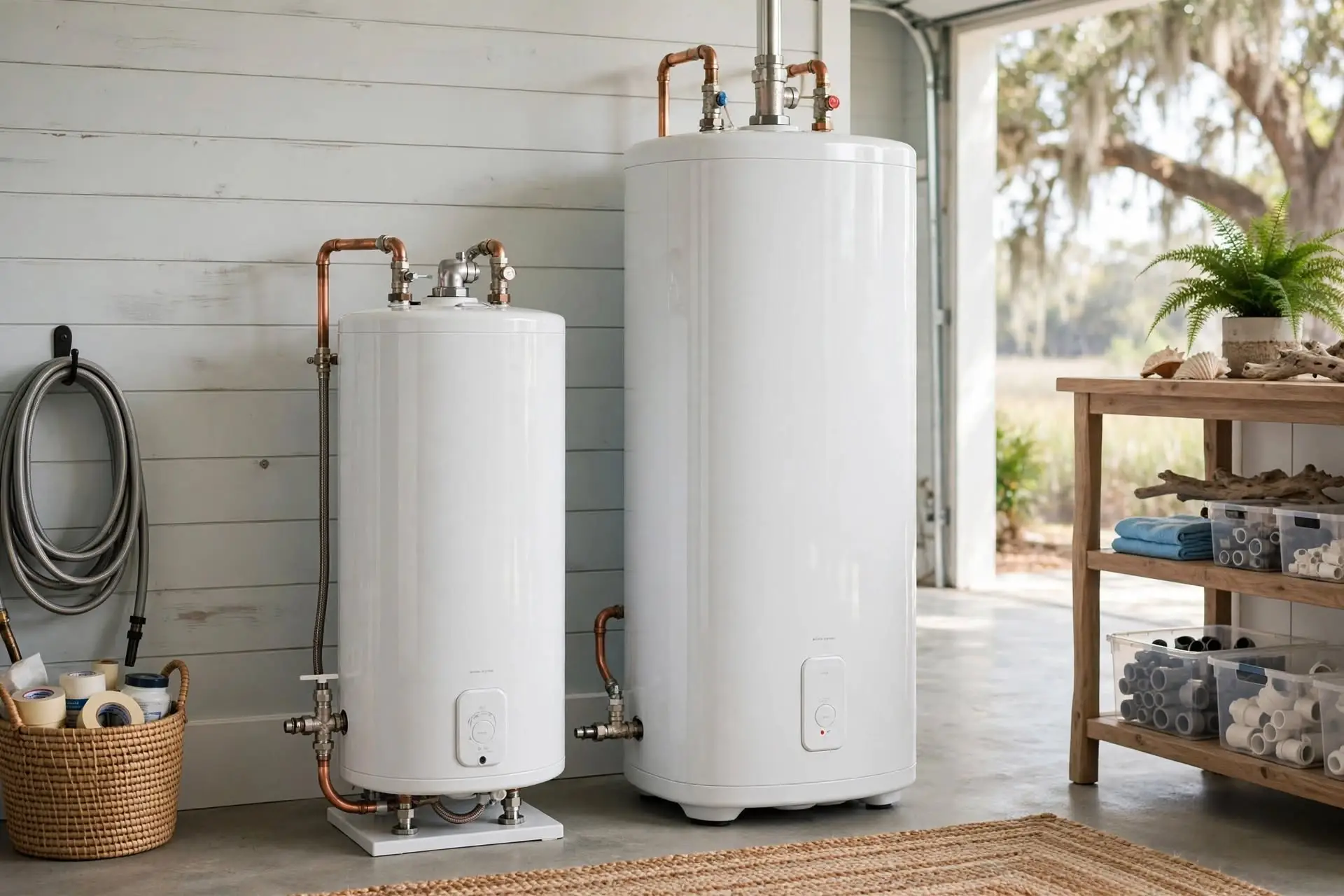
Water heaters quietly fail in Goose Creek homes at about half the lifespan they should. A unit rated for 12 to 15 years often gives up by year 7 or 8. The culprit is almost always the same: zero maintenance. Homeowners install a water heater, forget about it, and then replace it prematurely when it fails. The irony is that proper maintenance takes roughly 2 hours per year and can literally double how long the tank lasts.
This article walks you through the actual maintenance procedures that matter, the correct frequency for each task, and the specific techniques that work in Goose Creek’s hard-water conditions. No filler tips, just the step-by-step tasks that keep water heaters running reliably for 15+ years.
Your Goose Creek Water Heater Maintenance Schedule
Here is the maintenance calendar every Goose Creek homeowner should follow. The frequencies are tighter here than national averages because our hard water accelerates sediment buildup and corrosion.
| Frequency | Task | Why It Matters for Goose Creek |
| Every 6 months | TPR valve test | Prevents tank over-pressure explosion |
| Every 12 months | Full tank flush | Hard water doubles sediment rate here |
| Every 12 months | Thermostat calibration check | Prevents scalding and efficiency loss |
| Every 12 months | Expansion tank pressure check | Protects against water hammer damage |
| Every 12 months | Visible leak + fitting inspection | Catches slow leaks before damage |
| Every 2-3 years | Anode rod inspection | Replace when 6+ inches of core wire shown |
| Every 5-7 years | Full professional service | Comprehensive check of all components |
Following this schedule consistently adds 3 to 7 years to most water heater lifespans. Skipping any of these tasks for multiple years is how homeowners end up replacing water heaters at year 7 or 8 instead of year 12 or 15.
Task 1: The Annual Tank Flush (Highest-ROI Maintenance)
A full tank flush is the single highest-value maintenance task you can do on a water heater, especially in Goose Creek where hard water deposits sediment at 2 to 3 times the national average rate. Sediment sitting at the tank bottom acts as insulation that forces your heating element to work harder, reduces hot water capacity, and causes the popping noises that signal long-term damage.
How to Flush Your Water Heater (Step-by-Step)
- Turn off the power. Electric: flip the breaker. Gas: set to pilot or off.
- Close the cold water supply valve on top of the tank.
- Connect a garden hose to the drain valve at the tank bottom and run the other end to a floor drain, utility sink, or outside.
- Open a hot water faucet somewhere in the house (this breaks the vacuum).
- Open the drain valve and let the tank empty completely. Expect 20-40 minutes depending on tank size and sediment load.
- Briefly open the cold water supply valve to stir up remaining sediment, then close again. Repeat until water runs clear.
- Close the drain valve, disconnect the hose.
- Open the cold water supply valve to refill. Keep the hot water faucet open until water flows steadily (indicating the tank is full).
- Restore power/gas.
Expected time: 45 to 75 minutes. Expected impact: restored heating efficiency, eliminated popping noise, significantly reduced risk of premature tank failure.
Task 2: Anode Rod Inspection and Replacement
The anode rod is a sacrificial metal rod inside your water heater tank. Its job is to corrode so the tank does not. When the anode rod is fully corroded, your tank begins corroding next and will fail within 2 to 4 years. Replacing the anode rod at the right time is what turns a 10-year water heater into a 20-year water heater.
When to Check the Anode Rod
First inspection at year 3 for Goose Creek hard-water conditions. If the rod still has more than 6 inches of coating beyond the core wire, recheck in 2 years. If less than 6 inches of coating remains or more than 6 inches of bare core wire is exposed, replace immediately. Magnesium rods (standard) deplete faster in hard water than aluminum rods, so many Goose Creek homes benefit from switching to aluminum at replacement time.
Replacement Notes
Anode rod replacement requires a 1-1/16 inch socket wrench and considerable torque to break loose after years of corrosion. This task is technically DIY but not beginner-friendly. A stuck anode rod that rounds off under wrench pressure creates a problem that is more expensive to fix than just paying a plumber for the original replacement. If you have never done it before, the first replacement is worth paying for. Watch how the plumber does it, then handle future replacements yourself.
Task 3: TPR Valve Testing (Twice Yearly)
The temperature and pressure relief valve (TPR valve) is a critical safety device that releases water if tank pressure or temperature exceeds safe limits. A stuck TPR valve can cause a tank to explosively rupture. Testing takes 30 seconds.
How to Test the TPR Valve
- Place a bucket under the TPR discharge pipe.
- Lift the lever on the TPR valve gently and hold for 2-3 seconds. Water should flow vigorously.
- Release the lever. Flow should stop completely within a few seconds.
- If no water flows (stuck closed) or water continues dripping (stuck open), the valve needs replacement. Call a plumber.
Test twice a year. A TPR valve that has not been exercised for years often seizes up, which is exactly when you need it most. A 30-second test prevents a catastrophic tank failure.
Task 4: Thermostat Calibration (Annual)
Water heater thermostats drift out of calibration over time. A thermostat set to 120 degrees might actually be heating water to 135 or 140 degrees, which wastes energy and increases scald risk. Conversely, an old thermostat may only reach 110, leaving you with lukewarm showers.
How to Verify Thermostat Accuracy
Run hot water at the farthest fixture from the water heater for 2 minutes to purge cool pipe water. Collect a cup of hot water and measure with a food thermometer. Compare to the water heater setting. More than 10 degrees off in either direction means the thermostat needs adjustment or replacement. For most Goose Creek homes, 120 degrees is the optimal setting: hot enough to kill bacteria, cool enough to prevent scalding, efficient enough to reduce energy costs.
Task 5: Expansion Tank Check (Annual)
Expansion tanks are required in most Goose Creek homes with pressure regulators installed. They absorb the pressure buildup when water heats and expands, protecting pipes, fittings, and the water heater itself from water hammer damage. Most homeowners have no idea their expansion tank exists, let alone that it needs checking.
The Simple Annual Check
Locate the expansion tank (usually mounted on the cold water supply pipe above the water heater). Tap on it gently with a wrench or screwdriver handle. The top half should sound hollow (air-filled). The bottom half should sound dull (water-filled). If the entire tank sounds dull, the expansion tank bladder has failed and the tank is waterlogged. It needs replacement, which runs $150 to $250 installed.
A failed expansion tank causes pressure surges throughout your plumbing, shortens the life of every fixture, and stresses the water heater itself. A 30-second annual check catches this before the damage spreads.
Task 6: Annual Visual Inspection
A thorough visual inspection catches problems before they become emergencies. Spend 10 minutes once a year looking at every visible component.
- Top connections for any drip, corrosion, or white mineral buildup at fittings
- Tank exterior for any rust streaks, damp patches, or visible sweating
- Base/pan for any standing water or dampness (pan should be bone dry)
- Gas supply line and connections (for gas units) – check for rust, gas odor
- Flue/venting for any soot, corrosion, or disconnection (gas units)
- Electrical connections for any discoloration or loose wires (electric units)
- Insulation on hot and cold lines emerging from the tank
Any new rust, moisture, or corrosion catches your attention is worth a professional inspection. Small visible issues almost always have bigger underlying causes. Our article on the cost of water heater repairs versus replacement covers when these findings indicate a repair versus a full replacement.
Quick Note for Tankless Water Heater Owners
Tankless water heater maintenance looks different. No tank flush needed, but descaling is critical. Goose Creek hard water deposits scale on the heat exchanger at 2 to 3 times the rate of softer-water regions. Annual descaling with a pump and white vinegar or commercial descaler is essential for tankless longevity. Without it, heat exchangers clog within 3 to 5 years and become uneconomical to repair. Anode rods do not exist on tankless units. TPR testing still applies.
When to Call a Pro Instead of DIY
Most of the above tasks are legitimately DIY for handy homeowners. Some situations warrant calling a professional instead.
- Anode rod is stuck and will not budge under reasonable torque
- TPR valve fails the test and needs replacement
- Thermostat is off by more than 15 degrees or does not respond to adjustment
- Expansion tank is waterlogged and needs replacement
- Any visible tank exterior leak or pan with standing water
- Gas unit with any connection issues or gas smell
- Unit is 10+ years old and you want a full condition assessment
Professional Water Heater Maintenance When You Need It
Whether you want a plumber to handle all maintenance for you, to do a complete condition assessment, or to step in for specific tasks that are outside your comfort zone, Mueller’s Plumbing Service provides water heater maintenance across Goose Creek and the Tri-County area. Our annual maintenance visits include full flush, anode rod inspection, TPR testing, thermostat calibration, and a written condition report so you know exactly where your water heater stands.
Call us at (843) 572-8522, or visit our water heater repair service page to schedule maintenance. After 30 years of water heater work in the Tri-County area, we know exactly what Goose Creek’s water conditions demand, and our maintenance visits reflect that local expertise.