Hard water causes problems that most homeowners notice long before they identify what’s actually behind them. Scale buildup on faucets and showerheads, spots on dishes out of the dishwasher, dry skin and hair after showering, soap that doesn’t lather well, and appliances that fail earlier than they should are all signs of hard water at work. A whole-house water softener addresses all of those issues at the source by treating the water before it reaches any fixture or appliance in the home. Our team installs water softener systems across Goose Creek and the Tri-County area and sizes every system to match the home’s water hardness and household demand. Call us at (843) 572-8522 to schedule a free water hardness test.
Hard water is water that contains elevated concentrations of dissolved calcium and magnesium minerals. It’s not a health hazard, but it creates real problems throughout the home over time. Here are the signs that hard water is present.
This mineral crust is the most visible sign of hard water. It accumulates anywhere water sits or evaporates, including around faucet bases, on showerheads, and inside appliances.
Mineral deposits left behind when the water dries cause spotting on dishes even when the dishwasher is working correctly.
Hard water minerals react with soap and reduce its ability to create lather. You end up using more soap and detergent than you should to get the same cleaning result.
The same mineral interference that affects soap affects the way water interacts with skin and hair. Many people notice softer skin and more manageable hair quickly after switching to softened water.
Scale buildup inside water heaters, dishwashers, washing machines, and ice makers reduces efficiency and shortens service life. A water heater coated with scale inside uses more energy to heat the same volume of water and wears out faster.
Over years of use, scale accumulates inside pipes and reduces the effective diameter, which restricts flow. This is a slower-developing symptom but a real one in homes with hard water and no treatment.
The Charleston Water System serves much of the Goose Creek area. Water hardness in this region typically falls in the moderately hard range, measured at approximately 2 to 4 grains per gallon depending on the source and the time of year. While this is not extreme hardness by national standards, it’s enough to cause the scale buildup, soap inefficiency, and appliance wear described above over time. Homes on private wells in the surrounding area may have higher hardness levels depending on the geology of the well.
The right starting point is a water test that gives you the actual hardness reading for your home. We include this at no charge when we visit for a softener consultation.
Water softeners and water conditioners work differently, and the right type depends on your water chemistry and what outcomes matter most to you.
Salt-based softeners are the most widely used residential water treatment systems and the most effective at true water softening. They work by passing water through a resin bed that replaces calcium and magnesium ions with sodium ions, which do not cause scaling. The resin is periodically recharged using a salt brine solution, which flushes the collected minerals out of the system.
Salt-based softeners effectively eliminate hardness-related scaling, extend appliance life, and improve the performance of soaps and detergents. They require periodic salt refills and produce a small volume of brine discharge during the regeneration cycle.
Salt-free systems use a process called template-assisted crystallization to change the structure of calcium and magnesium minerals so they don’t bond to surfaces as readily. They don’t remove the minerals from the water, which means the water is technically still hard, but scale formation on surfaces and inside pipes is significantly reduced.
Salt-free systems require no salt, produce no brine discharge, and have very low maintenance requirements. They’re a good option for homeowners who want scale prevention without the ongoing cost of salt or the brine output of a traditional softener.
Dual-tank softeners have two resin tanks so that one can regenerate while the other is in service. This ensures softened water is available continuously, including during the regeneration cycle. Single-tank softeners are offline during regeneration, which typically happens overnight. For households with high water demand, a dual-tank system eliminates the gap in soft water supply.

The choice between salt-based and salt-free comes down to what you’re trying to accomplish and how much ongoing maintenance you’re willing to handle.
If your primary goal is to eliminate scaling on fixtures, inside appliances, and in pipes, and to get the full benefits of softened water including better soap lather and noticeably different water feel, a salt-based system is the right choice. It requires adding salt every few weeks to months depending on water usage and system size.
If your goal is to reduce scaling without the maintenance of salt refills or the brine discharge that comes with regeneration, a salt-free conditioner is worth considering. It won’t produce the same feel change that a traditional softener does, but it does address the scale problem effectively.
We discuss both options during the consultation and give you our recommendation based on your water hardness reading, your household’s water usage, and your preferences.
We’re not tied to a single brand and we install systems from reputable manufacturers including Kinetico, Culligan, Rheem, Fleck, and Aquasana. Our recommendation is based on which system fits your household demand, your water hardness level, and your budget. We register the manufacturer’s warranty on your behalf after installation.
We test the incoming water hardness at your home to get an actual grains-per-gallon reading rather than estimating from regional averages.
Softener sizing is based on water hardness and daily water usage. An undersized unit regenerates too frequently and wears out faster. An oversized unit wastes salt and doesn’t regenerate often enough to maintain resin efficiency. We calculate the right capacity for your household.
Softeners are typically installed in the garage, utility room, or near the water heater, at a point on the supply line before water reaches the water heater or any interior fixtures.
Every installation includes a bypass valve so the softener can be taken offline for service or salt refills without cutting off water to the home.
We set the regeneration schedule and salt dose based on your water hardness and household usage so the system operates efficiently from day one.
Before we leave, we show you how to add salt, how to check the salt level, and what the normal operating indicators look like so you can keep the system running without guesswork.
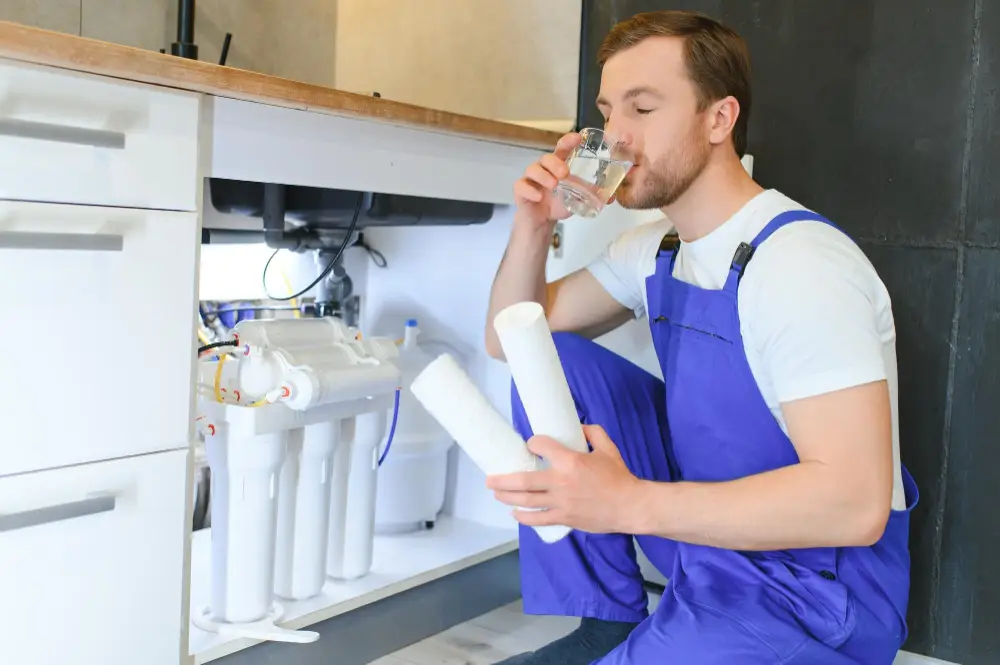
Installation cost depends on the type of system selected, the brand and capacity, and the installation location. Here are the general ranges for residential water softener installations in Goose Creek.
These are fully installed costs including the unit, all fittings and bypass hardware, and labor. Ask about financing if you’d like to spread the cost.
Softened water produces changes that most homeowners notice within days. Fixtures stop accumulating scale as quickly. Dishes come out of the dishwasher without spots. Skin and hair feel different after showering. Soap and shampoo lather more readily with less product. The water heater and other appliances run more efficiently as the existing scale is gradually flushed out over time.
The longer-term benefits show up in appliance lifespans and in plumbing that maintains its flow capacity rather than narrowing gradually from scale accumulation inside the pipes.
EXCELLENTTrustindex verifies that the original source of the review is Google. I hired Muller's Plumbing to fix the plumbing in my shower and they were great. Very professional, polite, worked looked great, arrived on time and worked in a timely fashion. I would hire them again.Posted onTrustindex verifies that the original source of the review is Google. Knowledgeable and ready to get it done. Made the whole process of dealing with the insurance co, leak detection, restoration company SEAMLESS. Took all the stress away from a very stressful problem.Posted onTrustindex verifies that the original source of the review is Google. I needed to have a plumber come out on a Friday afternoon to check on a possible water leakage and Mueller Plumbing was able to come out in a timely manner and able to find the issue and fixed it quickly. Highly Recommend.Posted onTrustindex verifies that the original source of the review is Google. They were the only company in goose creek that would help us in a timely fashion. They shuffled around a few things to make sure my restaurant was able to stay open! We will use them again!Posted onTrustindex verifies that the original source of the review is Google. Grant installed our water heater a few years back, so I called him when we needed work done recently. He is very knowledgeable about the work he does, and he likes to make sure you are good to go before he leaves! One thing I would recommend, as with any company, make sure you are clear on pricing and what your quote covers.Posted onTrustindex verifies that the original source of the review is Google. I had Mr. Mueller come all the way out from Goose Creek to fix a burst pipe. He came and fix it quickly. I would recommend him to others, as he was honest in his work.Posted onTrustindex verifies that the original source of the review is Google. Grant is polite and an expert in his craft. I called him about a leak under my house and felt immediately reassured. He responds to calls with a degree of professionalism and motivation unmatched by most other tradesmen, and I feel utterly certain that he will be my plumber of choice for the foreseeable future.Posted onTrustindex verifies that the original source of the review is Google. Mueller Plumbing did an amazing job replacing a water heater in my mother's house. Clean, fast service. Very professionalPosted onTrustindex verifies that the original source of the review is Google. Had the pleasure of working with Mr. Mueller today to replace my kitchen faucet, his service was excellent and quick. Highly recommend to anyone and based of other reviews the consensus is nothing but good things to say all around. Will definitely be calling him again with any future issues.
We start with an actual water test at your home before recommending any system. We size units based on real household data rather than defaulting to whatever’s in stock. We’re brand-neutral and make recommendations based on what fits the job. Our team is family-owned, licensed, and has been serving Goose Creek and the surrounding communities for more than 30 years. Every installation comes with a full walkthrough so you know how to maintain the system going forward.
Residential water softener installation in Goose Creek typically runs between $1,200 and $4,000 fully installed, depending on the system type and capacity. Dual-tank systems can run higher. We provide a written estimate after the water test and consultation.
For most households, every four to eight weeks. Homes with higher water hardness or higher water usage go through salt faster. We set up the regeneration schedule during installation based on your specific conditions so you have a realistic sense of the maintenance schedule.
They work at preventing scale formation, which is what most homeowners want from a water treatment system. What they don’t do is change the mineral content of the water or produce the soft water feel that a salt-based ion exchange system does. For scale prevention without salt maintenance, they’re effective. For the full range of benefits including lather improvement and water feel, a salt-based system is the better choice.
A salt-based water softener installed correctly and maintained with regular salt refills typically lasts 15 to 20 years. Salt-free conditioners have very few moving parts and often last longer. The control valve on a salt-based system is the component most likely to need service over the life of the unit.
A standard water softener does not remove chlorine. Softeners are designed specifically to remove hardness minerals through ion exchange, not to filter other contaminants. If chlorine taste or odor is a concern, a carbon filter added to the system will address it. We can incorporate filtration into the installation when it’s relevant to your water quality situation.
Let’s ask something to us! Reach out I’d love to hear about your question about our services.
