Clean water from every tap in your home isn’t something you should have to think twice about. If you’re noticing a chlorine taste or smell, occasional discoloration, or sediment showing up in aerators and fixtures, the water coming in from the main line may have more in it than you’d like. A whole-house water filtration system treats water at the point it enters the home, so every faucet, shower, and appliance downstream gets filtered water. Our team installs water filtration systems of all types across Goose Creek and the Tri-County area and starts every installation with an actual water quality test rather than a guess. Call us at (843) 572-8522 to schedule a free water quality consultation.
City water in South Carolina goes through treatment at the utility level, but that treatment is designed to meet regulatory minimums across a large distribution network, not to address the specific water quality conditions at your home. By the time water travels through miles of aging distribution pipe and enters your home, it can pick up chlorine and chloramines used in disinfection, sediment, dissolved minerals, and in some areas, trace contaminants from older infrastructure.
Private well users face a different set of considerations. Wells are not subject to municipal treatment standards and can carry iron, manganese, bacteria, nitrates, or other naturally occurring contaminants depending on the local geology and land use near the well.
Here are the signs that a filtration system is worth investigating.
Municipal water is treated with chlorine or chloramines, which are effective disinfectants but leave a taste and odor that many people find unpleasant. This is one of the most common reasons homeowners install filtration.
Particles settling out in your aerators or accumulating in the toilet tank are a sign that sediment is entering the supply. A sediment pre-filter addresses this and also protects downstream filters and appliances.
Periodic brown or yellow water, particularly when a fixture hasn't been used for a while, can indicate iron, sediment, or distribution pipe material entering the line.
Municipal utilities publish annual water quality reports. If yours shows elevated levels of chloramines, disinfection byproducts, or any contaminants of concern, a filtration system matched to those specific issues is a reasonable next step.
Homes built before the 1980s may have lead solder at pipe joints. While the risk is generally low with properly maintained municipal water, a filter certified to reduce lead provides additional assurance.
The contaminants a filtration system removes depend entirely on the type of system and the filter media used. Here’s a general breakdown.
remove particles, sand, rust, and suspended solids. They protect downstream filters and appliances from particulate buildup but don’t affect dissolved chemical contaminants.
remove chlorine, chloramines, volatile organic compounds, some pesticides, and certain disinfection byproducts. They improve taste and odor significantly and are the core filter stage in most whole-house systems.
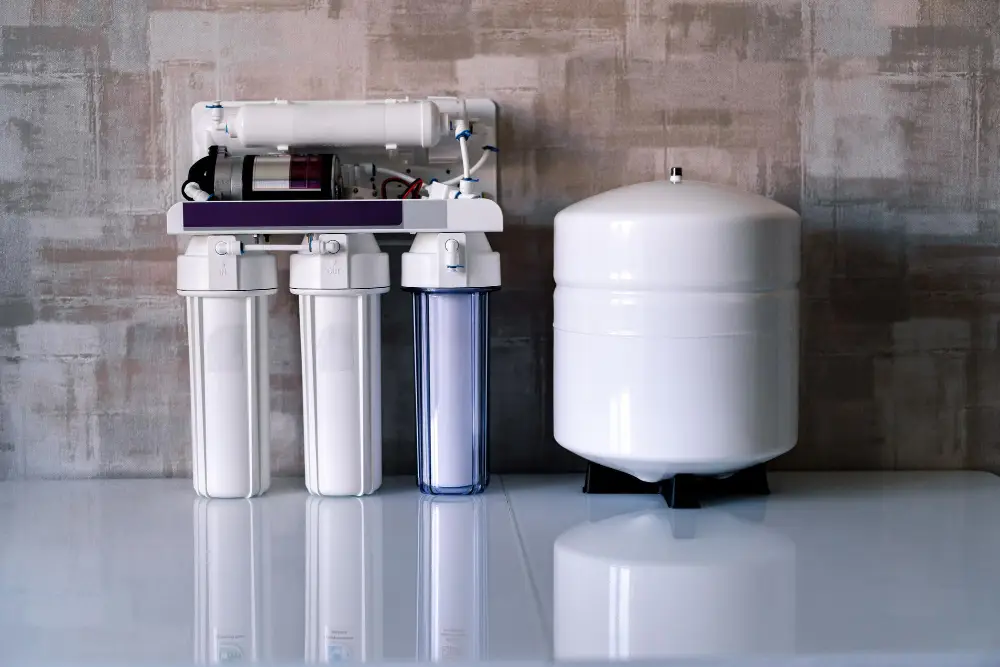
remove dissolved solids including heavy metals like lead and arsenic, nitrates, fluoride, certain pharmaceuticals, and a wide range of ionic contaminants. RO is one of the most thorough filtration methods available for drinking water.
neutralize bacteria, viruses, protozoa, and other biological contaminants through UV light exposure. They leave no residual disinfectant in the water and work without chemicals.
address chloramines more effectively than standard activated carbon, which makes them a better choice for municipal water systems that use chloramines rather than chlorine for disinfection.
The right filter must match the contaminant. A carbon filter won’t address bacteria, and a UV system won’t remove chlorine. Starting with a water test tells us what’s actually in your water and ensures the system we recommend is the right one for your situation.
These two approaches serve different purposes and many households use both.
A whole-house filtration system treats all the water entering the home. Every tap, shower, and appliance gets filtered water. This matters for shower water, which is absorbed through the skin and inhaled as steam, not just drinking water. It also protects appliances from sediment and chlorine that degrade seals and heating elements over time.
A point-of-use system filters water at a specific location, usually the kitchen sink, for drinking and cooking. Reverse osmosis systems are almost always point-of-use installations because of the flow rate and storage limitations of the technology.
Combining a whole-house system for general filtration with an under-sink RO system for drinking water gives you the broadest coverage. The whole-house system does the heavy lifting on chlorine and sediment, which also extends the life of the RO membrane significantly.
We test the incoming water for hardness, chlorine or chloramine levels, sediment, pH, and any specific contaminants relevant to your situation. This drives the system recommendation.
Based on the test results and your priorities, we recommend the filter type, media, and configuration that addresses what’s actually in your water.
Whole-house systems are installed on the main supply line inside the home, typically in the garage or utility room. Under-sink systems are installed at the specific tap, with a dedicated filtered water faucet on the sink.
Some systems require an initial flush and have programmed backwash or regeneration cycles. We configure these correctly during installation.
Every filter system has a maintenance schedule that keeps it performing correctly. We walk you through what needs to be changed, when, and how before we leave.
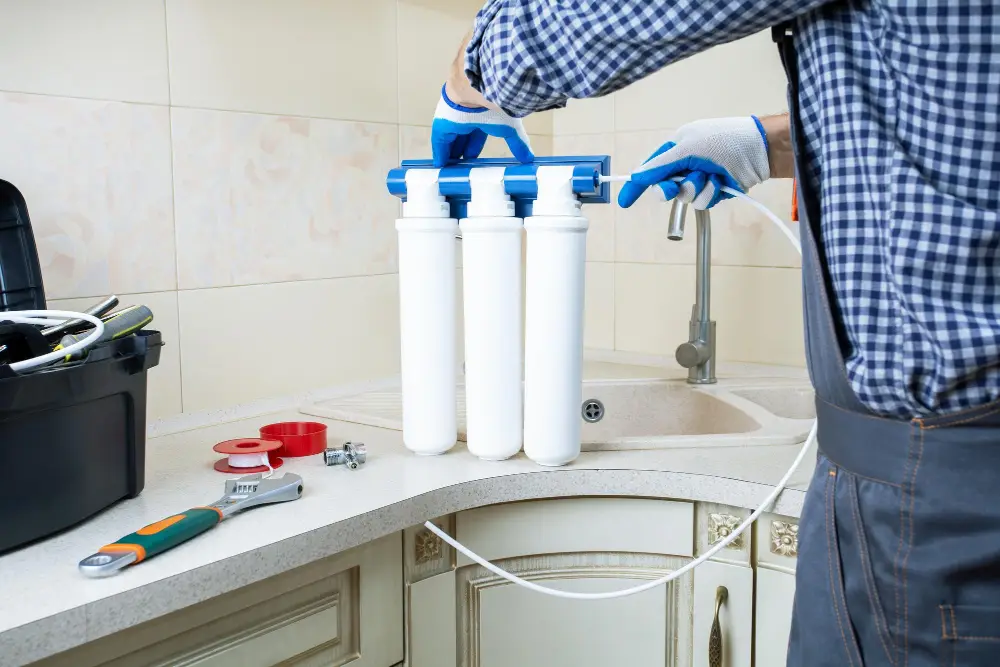
Installation costs vary based on the system type, the number of filter stages, and the accessibility of the installation point. Here are the general ranges for residential installations in Goose Creek.
These are fully installed costs including the unit, all fittings and connections, and labor. Filter replacement ongoing costs vary by system but typically run $50 to $250 per year depending on filter type and usage.
A filtration system that isn’t maintained stops performing. Here are the general filter replacement schedules for the main system types.
Sediment pre-filters typically need replacement every three to six months. Carbon block filters last six to twelve months under normal usage. RO membranes have a longer service life of two to three years but require the pre-filters around them to be changed on schedule to avoid premature membrane fouling. UV lamp bulbs need replacement annually to maintain effective output.
We offer a maintenance plan for filtration systems we install. Annual visits confirm the system is performing correctly, filter replacements are on schedule, and no connections have developed issues since the last service.
EXCELLENTTrustindex verifies that the original source of the review is Google. I hired Muller's Plumbing to fix the plumbing in my shower and they were great. Very professional, polite, worked looked great, arrived on time and worked in a timely fashion. I would hire them again.Posted onTrustindex verifies that the original source of the review is Google. Knowledgeable and ready to get it done. Made the whole process of dealing with the insurance co, leak detection, restoration company SEAMLESS. Took all the stress away from a very stressful problem.Posted onTrustindex verifies that the original source of the review is Google. I needed to have a plumber come out on a Friday afternoon to check on a possible water leakage and Mueller Plumbing was able to come out in a timely manner and able to find the issue and fixed it quickly. Highly Recommend.Posted onTrustindex verifies that the original source of the review is Google. They were the only company in goose creek that would help us in a timely fashion. They shuffled around a few things to make sure my restaurant was able to stay open! We will use them again!Posted onTrustindex verifies that the original source of the review is Google. Grant installed our water heater a few years back, so I called him when we needed work done recently. He is very knowledgeable about the work he does, and he likes to make sure you are good to go before he leaves! One thing I would recommend, as with any company, make sure you are clear on pricing and what your quote covers.Posted onTrustindex verifies that the original source of the review is Google. I had Mr. Mueller come all the way out from Goose Creek to fix a burst pipe. He came and fix it quickly. I would recommend him to others, as he was honest in his work.Posted onTrustindex verifies that the original source of the review is Google. Grant is polite and an expert in his craft. I called him about a leak under my house and felt immediately reassured. He responds to calls with a degree of professionalism and motivation unmatched by most other tradesmen, and I feel utterly certain that he will be my plumber of choice for the foreseeable future.Posted onTrustindex verifies that the original source of the review is Google. Mueller Plumbing did an amazing job replacing a water heater in my mother's house. Clean, fast service. Very professionalPosted onTrustindex verifies that the original source of the review is Google. Had the pleasure of working with Mr. Mueller today to replace my kitchen faucet, his service was excellent and quick. Highly recommend to anyone and based of other reviews the consensus is nothing but good things to say all around. Will definitely be calling him again with any future issues.
We don’t recommend a system before we know what’s in your water. The water test comes first, and the system recommendation follows from the results. We’re brand-neutral, which means we recommend the system that fits the situation rather than the one we happen to stock most of. Our team is family-owned, licensed, and has been serving Goose Creek homeowners for more than 30 years. Every installation comes with a full walkthrough of the maintenance schedule so the system keeps working the way it should.
Whole-house water filtration systems in Goose Creek typically run between $1,200 and $4,500 fully installed, depending on the number of filter stages and the addition of UV purification. Under-sink RO systems run $500 to $1,200. We provide a written estimate after the water test.
City water meets regulatory standards, but those standards allow for certain disinfectants, disinfection byproducts, and trace contaminants at levels the EPA considers acceptable. If you want better taste, less chlorine exposure, or protection from contaminants not fully addressed by municipal treatment, a filtration system is worth considering. A water test tells you what’s actually present in your supply.
It depends on the filter type. Sediment filters typically last three to six months. Carbon filters last six to twelve months. RO membranes last two to three years. We set you up with a specific schedule for your system during installation.
A water softener removes hardness minerals, specifically calcium and magnesium, through ion exchange. A water filter removes a different set of contaminants depending on the media used, including sediment, chlorine, heavy metals, and biological contaminants. Many households benefit from both. They can be installed together and each does a job the other doesn’t.
RO systems remove most dissolved minerals, including some that contribute to dietary intake like calcium and magnesium. The amounts removed are small relative to dietary intake from food, and most people drinking RO water do not experience any nutritional difference. If this is a concern, RO systems with remineralization cartridges add a small amount of minerals back into the water after filtration.
Let’s ask something to us! Reach out I’d love to hear about your question about our services.
